
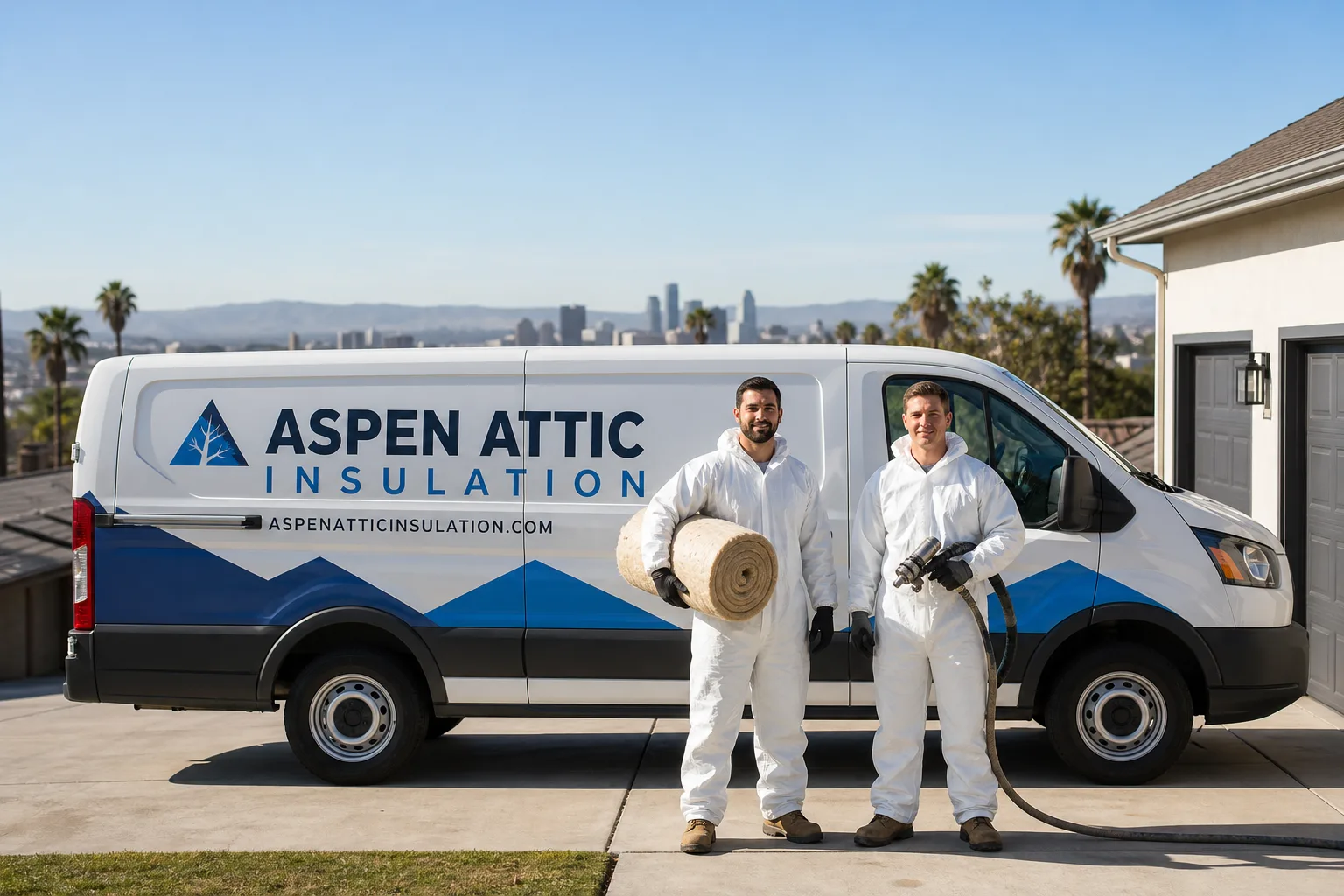
Fast, Reliable Attic Insulation Across Desert Hot Springs
Attic insulation in Desert Hot Springs runs $1,800 – $4,500 for most homes, with same-week scheduling available and crews dispatched from our Inland Empire office. We know the 1950s – 1970s slab-on-grade homes off Palm Drive and Pierson Boulevard, the newer tracts near Mission Lakes, and the wind-scoured attics that lose R-value faster here than anywhere else in the Coachella Valley.
Call (864) 428-1615 for a free written estimate. Our Attic Insulation team serves Desert Hot Springs with background-checked, photo-badged technicians whose names and faces you get before anyone knocks.
Why Aspen Attic Insulation Is Desert Hot Springs’s Preferred Attic Insulation Company
We’ve worked in Desert Hot Springs long enough to recognize the pattern: a homeowner calls after their summer electric bill spikes, we open the attic, and find sand-packed batts sagging off joists or cellulose clumped near an evaporative cooler plenum. Our crews know what to look for because we’ve handled it before.
Our technicians arrive under The Threshold Standard, founded in 2002. That means identity verification, background checks, clean marked uniforms, and photo ID badges shown at your door. You receive the technician’s name and photo before the visit. If anyone else shows up, the visit is free and we make it right.
Every job carries our 365-Day Done Right Promise in writing. If a repair fails, we come back free. Every price is written and agreed to before work starts. No post-job surprises.
A live person answers our phones 24/7. No voicemail loops.
Insulation Contractors in Desert Hot Springs
Insulation Contractors in Desert Hot Springs handle a specific set of problems you won’t find in every California market. The job involves assessing existing attic insulation, measuring current R-value, identifying air leaks and ventilation gaps, then installing blown-in fiberglass, batt insulation, or spray foam matched to your home’s age and condition. Most Desert Hot Springs homeowners call us after noticing uneven room temperatures, spiking summer electric bills, or seeing sand sift through ceiling fixtures.
A typical attic insulation top-up in Desert Hot Springs runs $1,800 – $2,800. Full replacement with air sealing ranges $3,200 – $4,500. Homes with evaporative coolers or extensive sand infiltration may need additional prep work.
Blown-In Attic Insulation
Blown-in insulation (loose fibers blown into the attic cavity to fill every gap) works especially well in Desert Hot Springs’s older homes with irregular joist spacing or multiple penetrations. We use Owens Corning and Knauf fiberglass products, blown to R-38 or higher, with baffles installed at eaves to maintain airflow and prevent wind-driven sand from entering living spaces.
Attic Batt Insulation and Replacement
When existing batts are too degraded to salvage, we remove them entirely, vacuum out sand and debris, air-seal top plates and penetrations, then install new Rockwool or Johns Manville batts. This is common in 1960s – 1970s homes off Two Bunch Palms Trail where original R-11 batts have baked out and delaminated.
Attic Ventilation in Desert Hot Springs
Attic Ventilation in Desert Hot Springs is not optional, it’s structural. Without proper airflow, 105°F+ attic temperatures radiate downward, your evaporative cooler or AC runs constantly, and wind-driven sand accumulates in stagnant corners. The job involves calculating intake and exhaust balance, installing or replacing baffles, ridge vents, or static vents, and ensuring insulation doesn’t block soffit airflow. Most ventilation prep work runs $400 – $900 as a standalone service, or is bundled into full insulation jobs.
Desert Hot Springs’s position near the San Gorgonio Pass creates unique ventilation challenges. The same winds that cool your patio at 3 p.m. are forcing fine sand through every unscreened vent and gap in your roofline.
Baffles and Intake Sealing
We install wind-resistant baffles at every eave, paired with fine-mesh vent screens that stop sand without choking airflow. In homes near the pass-facing edge of Desert Hot Springs, this step alone prevents the dust-loading that ruins insulation in three to five years instead of fifteen.
Radiant Barrier Integration
For flat or low-pitched roofs common in Desert Hot Springs’s mid-century stock, we staple radiant barriers to rafters after insulation installation. This reflects attic heat gain downward and can reduce cooling load by 10 – 15% in homes with unconditioned attics. Not every roof geometry benefits equally, we assess yours before recommending it.
Trusted Brands We Service in Desert Hot Springs
We stock materials from eight industry-leading brands: Owens Corning, Johns Manville, Knauf, Rockwool, CertainTeed, Icynene, Demilec, and GreenFiber. For Desert Hot Springs customers, this means no waiting on special orders when your attic is hitting 120°F and your cooler won’t keep up. We match the product to the specific failure mode: Rockwool for fire resistance and moisture tolerance near cooler plenums, Knauf fiberglass for blown-in retrofits in sand-compromised attics, CertainTeed batts for clean replacement jobs where moisture isn’t a factor. Our Inland Empire warehouse keeps core inventory on hand for next-day starts.
Common Attic Insulation Problems We See in Desert Hot Springs Homes
- Sand-compacted batts losing R-value. Wind from the San Gorgonio Pass pushes fine silica through attic vents, settling between fibers and causing batts to compress and sag off joists. We’ve pulled batts in Desert Hot Springs that measured R-8 on paper but performed like R-4 due to dust loading.
- Evaporative cooler moisture clumping cellulose. Homes running swamp coolers introduce humidity into attics with poorly sealed plenums. Cellulose and some mineral wools absorb this moisture, clump, and can support mold on organic binders. We see this most in older homes near Palm Drive where coolers run May through October.
- Original R-11 batts baked and delaminated. Desert Hot Springs’s 1950s – 1970s housing stock often has fiberglass batts that have spent sixty years cycling between 40°F winter nights and 140°F attic peaks. The facing separates, the fibers degrade, and gaps open at eaves where unfiltered heat pours straight into living spaces.
- Blocked soffit vents from added insulation. Well-meaning DIY top-ups or older contractor work often stuffs insulation tight against eaves, killing airflow and creating stagnant, superheated zones. We find this in ranch-style homes throughout the Miracle Hill area and near Desert Hot Springs High School.
Pricing for Attic Insulation in Desert Hot Springs, CA
Here’s what most Desert Hot Springs homeowners pay:
| Service | Typical Range |
|---|---|
| Attic insulation top-up (blown-in over existing) | $1,800 – $2,800 |
| Full attic insulation removal and replacement | $3,200 – $4,500 |
| Attic insulation replacement with air sealing | $3,800 – $5,200 |
| Attic baffles and ventilation prep | $400 – $900 |
| Radiant barrier installation (rafter-stapled) | $1,200 – $2,100 |
Your actual price depends on attic square footage, current insulation condition, accessibility, and whether we find sand infiltration or moisture damage requiring remediation. We inspect, measure, and deliver a written price before any work begins. No exceptions. Estimates are free. Call (864) 428-1615 to schedule.
We Also Serve Cities Near Desert Hot Springs
Our crews work throughout the Coachella Valley, including Desert Hot Springs neighbors in Palm Springs, Cathedral City, Thousand Palms, and Rancho Mirage. Each community has different housing stock and climate exposure, we adjust our recommendations accordingly.
Serving Desert Hot Springs, CA - Our Local Coverage Area
We’re based in the Desert Hot Springs area and know this community well. Use the map below to see our service coverage - if you’re nearby, we can almost certainly help.
FAQs About Attic Insulation in Desert Hot Springs
San Gorgonio Pass wind pushes fine sand through your attic vents, compacting and dust-loading insulation in ways Palm Springs homes rarely experience. That abrasion, combined with evaporative cooler moisture in many Desert Hot Springs attics, degrades R-value faster than the calmer, drier conditions south of the pass. Call (864) 428-1615 for a free inspection and written estimate.
We don’t recommend it if the existing batts are sand-loaded, moisture-damaged, or delaminated. Adding new insulation over failed material traps problems and gives you less performance than the depth suggests. We typically remove degraded batts, vacuum debris, air-seal, then blow new fiberglass to R-38. Call (864) 428-1615 and we’ll assess what’s actually up there.
Yes, if your attic is unconditioned and you have adequate existing insulation. Flat and low-pitched roofs have less attic volume to absorb heat, so radiant heat transfer downward is more aggressive. We staple barrier to rafters after insulation work, which can cut attic heat gain significantly. It won’t help if your insulation is already failing, fix that first. Call for a written assessment.
Only if the cooler plenum and attic penetrations aren’t properly sealed. We air-seal all plenum joints, top plates, and wire penetrations before installing insulation, and we specify moisture-tolerant materials like Rockwool or certain fiberglass products near cooler locations. With proper prep, your cooler and your insulation coexist fine. Call (864) 428-1615 to schedule.
Replace if you see: batts sagging or fallen from joists, visible sand accumulation, moisture staining or clumping, or R-value below R-19 in a climate that demands R-38. Repair or top-up only works when existing insulation is clean, dry, and properly positioned. We give you an honest assessment and a written price either way. Call (864) 428-1615 for a free inspection.
Written by Garrett Sloane, Owner at Aspen Attic Insulation, serving Desert Hot Springs since 2002.