
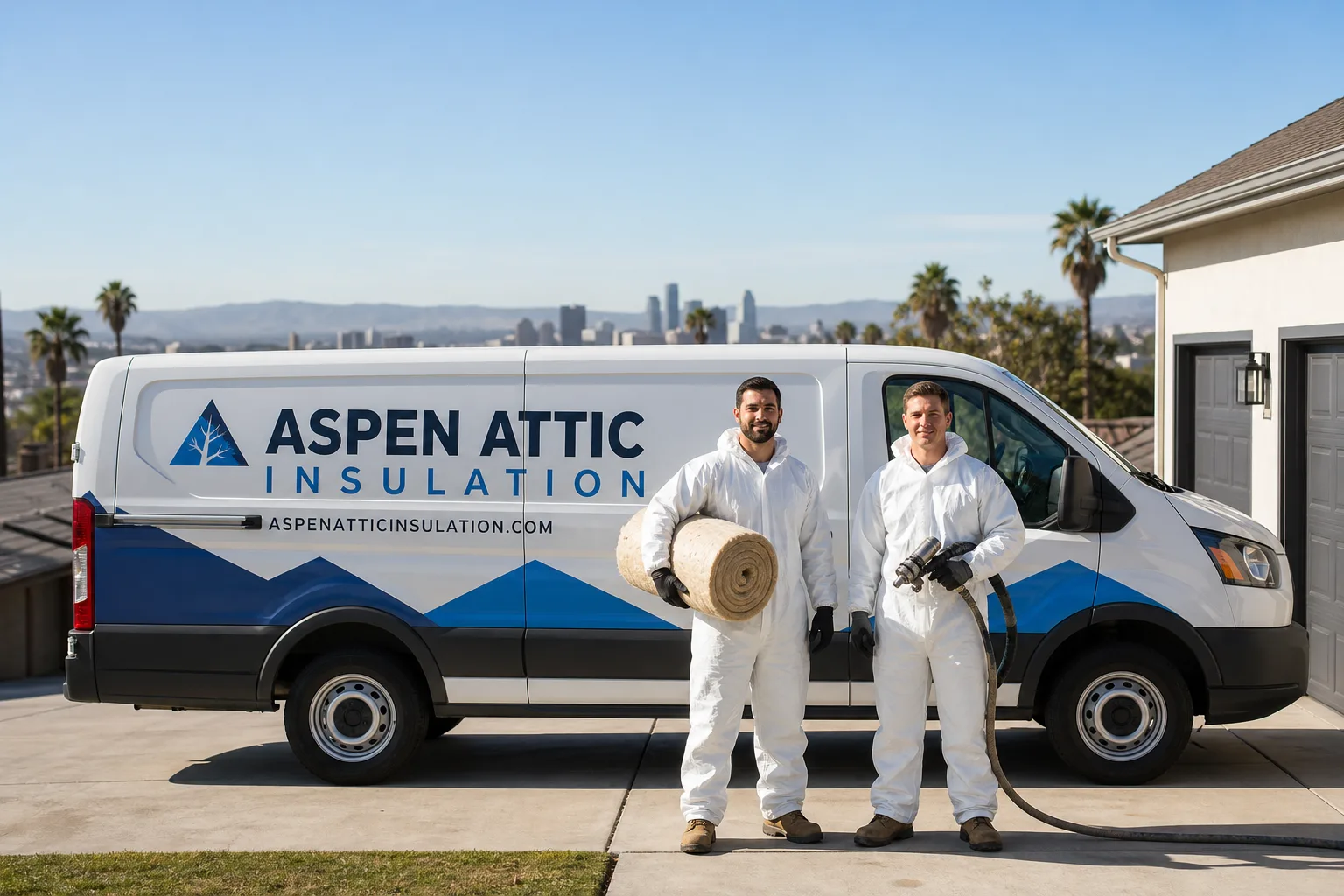
Fast, Reliable Spray Foam Insulation Across Joshua Tree
Spray foam insulation in Joshua Tree typically costs between $2,800 and $7,500 depending on whether we’re sealing a small homesteader cabin or a modern build, and most jobs are completed in one to two days. We dispatch crews from our Inland Empire office to serve Joshua Tree directly, with scheduling coordinated for the high-desert drive time.
We’ve worked on enough Joshua Tree homes to know the local pattern: a 1960s cabin off Sunfair Road with a shallow, unvented attic and tar paper walls, or a 1970s tract house near the north side that was never properly sealed against 30-40°F temperature swings. Our Spray Foam Insulation team doesn’t quote from a template. We inspect first, because Joshua Tree’s building stock demands it. Call (864) 428-1615 for a free written estimate.
Why Aspen Attic Insulation Is Joshua Tree’s Preferred Spray Foam Insulation Company
Garrett Sloane built Aspen Attic Insulation on the Threshold Standard, and that matters in a town where strangers knock on doors offering quick fixes for off-grid cabins. Every technician we send to Joshua Tree is background-checked, identity-verified, and photo-badged. You’ll get their name and photo before they arrive. If anyone else shows up, the visit is free and we make it right.
Our 365-Day Done Right Promise covers every job in writing. If the repair fails, we come back free. We also put the price in writing before any work starts, no exceptions. That’s not common in high-desert contracting, and we know Joshua Tree homeowners notice the difference.
Calls are answered by a live person 24/7. No voicemail loops, no “we’ll call you back tomorrow” when your cabin’s losing heat through a 35°F night swing.
Open Cell Spray Foam in Joshua Tree
Open Cell Spray Foam in Joshua Tree works best for interior wall cavities, sound dampening between rooms, and attic applications where moisture management is already handled. A typical open-cell job in Joshua Tree runs $2.80 to $4.20 per board foot installed, so a 1,200-square-foot homesteader cabin with standard 2×4 walls might run $3,200 to $4,800 for wall insulation only. We don’t recommend open-cell for unvented roof decks here, where Joshua Tree’s intense solar gain and trapped moisture can degrade the foam over time.
Where Open-Cell Fits Joshua Tree Homes
Open-cell shines in permitted 1970s-80s tract homes with standard framing and existing soffit ventilation. The foam expands to fill every gap, cuts air infiltration by up to 50%, and costs less per R-value than closed-cell. In a Joshua Tree bedroom addition or studio build with proper venting, it’s often the right call.
Sound and Air Sealing Benefits
Joshua Tree’s short-term rental market has exploded, and many owners need sound control between units. Open-cell’s density absorbs sound better than closed-cell. We regularly install it in partition walls of converted cabins near the village center, where guests and owners share the same roof.
Spray Foam Insulation Contractors in Joshua Tree
Spray Foam Insulation Contractors in Joshua Tree need to understand more than foam chemistry. They need to read a homesteader cabin’s roof pitch, spot a non-permitted addition’s missing wall cavities, and know when ventilation has to come first. A typical closed-cell job in Joshua Tree runs $4.50 to $7.50 per board foot, with full attic and wall retrofits on older homes landing between $5,500 and $7,500. Small rim joist or garage ceiling jobs start around $2,800.
The Threshold Standard on Every Job
Our technicians arrive in clean marked uniforms, show a photo ID badge at the door, and have already sent you their name and photo. The Threshold Standard requires this every visit, every time. In Joshua Tree, where many homes are off the beaten path and homeowners are often alone, this protocol isn’t extra. It’s expected.
Ventilation-First Assessment
We won’t spray foam into an unvented attic without a plan. In Joshua Tree, that means checking for soffit vents, ridge vents, or gable vents first. If they’re missing, we design a ventilation path before foam touches framing. Skipping this step traps moisture in old tar paper and wood, and we’ve seen the rot that follows.
Trusted Brands We Service in Joshua Tree
We stock materials from eight industry-leading brands so the right product goes in, not just what’s on the truck. For Joshua Tree’s high-desert conditions, we frequently specify Johns Manville and Knauf for their thermal stability across extreme temperature swings, and CertainTeed where fire resistance ratings matter on exposed applications. Rockwool’s mineral wool complements spray foam in hybrid systems for west-facing walls that see brutal afternoon sun. We don’t push one brand. We match the material to your home’s framing, ventilation, and whether it’s a weekend cabin or a full-time residence.
Common Spray Foam Insulation Problems We See in Joshua Tree Homes
- Moisture trapped in unvented homesteader roofs. Spray foam applied directly to the underside of a low-pitch roof with no soffit vents locks humidity against old tar paper and framing. We see this in cabins off Sunfair Road and throughout the original homestead sections. The fix is ventilation first, then foam.
- Delamination on non-standard wall cavities. Unpermitted cabins often have walls built from scrap lumber with no consistent stud spacing. Foam sprayed onto these surfaces can’t adhere properly, creating voids that let air through and eventually cause the foam to pull away.
- Heat gain overwhelming thin foam on south and west walls. Joshua Tree’s solar radiation is intense. Closed-cell foam needs proper thickness and often a thermal barrier on interior west- and south-facing walls. Without it, the wall still radiates heat into living space after sunset.
- Compressed fiberglass batts stuffed into open rafter bays. Homeowners try to fix cabin heat loss themselves, but compressed batts lose R-value and block what little ventilation exists. We remove these, design airflow, then apply foam that actually seals.
Pricing for Spray Foam Insulation in Joshua Tree, CA
Here’s what spray foam insulation costs in Joshua Tree’s market right now:
| Application | Price Range |
|---|---|
| Open-cell walls (standard 2×4 framing) | $2.80 – $4.20 per board foot |
| Closed-cell walls or roof deck | $4.50 – $7.50 per board foot |
| Small rim joist or garage ceiling | $2,800 – $4,200 |
| Full cabin retrofit (walls + attic) | $5,500 – $7,500 |
| Large modern home (2,500+ sq ft) | $7,500 – $12,000 |
What moves the price: accessibility of the work area, whether ventilation must be added first, the condition of existing framing, and whether we’re working with standard cavities or improvising around non-standard construction. Every Joshua Tree job gets a written price before work starts. Estimates are free. Call (864) 428-1615.
We Also Serve Cities Near Joshua Tree
Our crews work throughout the high desert and Coachella Valley, including Joshua Tree neighbors in Yucca Valley, Twentynine Palms, Desert Hot Springs, and Thousand Palms. The same Threshold Standard, same written pricing, same technician verification applies wherever we go.
Serving Joshua Tree, CA - Our Local Coverage Area
We’re based in the Joshua Tree area and know this community well. Use the map below to see our service coverage - if you’re nearby, we can almost certainly help.
FAQs About Spray Foam Insulation in Joshua Tree
Yes, but only after we add ventilation. We install gable vents, mini ridge vents, or other airflow paths first, then apply closed-cell spray foam directly to the roof deck. We were called to a 1960s homesteader cabin off Sunfair Road where the owner had stuffed fiberglass batts into the open rafter bays of a low, unvented attic with no soffit vents – you could see daylight through the tar paper walls. Our tech removed the compressed batts, added a small gable vent and a mini ridge vent to create a ventilation path, then applied 2 inches of closed-cell spray foam directly to the roof deck to seal and insulate in one step. The homeowner reported the cabin finally held heat overnight through a 35°F temperature swing, and the spray foam also stiffened the old roof structure. Call (864) 428-1615 if your cabin has this profile.
It can, but the approach changes. We often frame out proper cavities first or use closed-cell as both insulation and structural reinforcement on irregular surfaces. We won’t quote until we see the framing, because unpermitted Joshua Tree cabins vary too much. The written estimate is free.
Closed-cell spray foam handles Joshua Tree’s extreme diurnal swings better. Its higher R-value per inch and rigid structure resist both conductive heat gain in summer and rapid overnight heat loss. Open-cell works for interior walls with proper ventilation but isn’t our first choice for roof decks or exterior walls here.
These homes usually have standard framing and some existing ventilation, so we can often proceed directly to air sealing and foam application. We typically find gaps around top plates, recessed light fixtures, and duct penetrations that leak conditioned air. Closed-cell in walls and open-cell in vented attics is a common combination. Call (864) 428-1615 for a free assessment.
We specify from eight brands including Johns Manville, Knauf, and CertainTeed, matched to your home’s specific conditions. The choice depends on fire rating requirements, exposure to sunlight, and whether we need hybrid systems with Rockwool for west-facing walls. We don’t default to one product. Call (864) 428-1615 and we’ll explain what fits your build.
Written by Garrett Sloane, Owner at Aspen Attic Insulation, serving Joshua Tree and the high desert.