
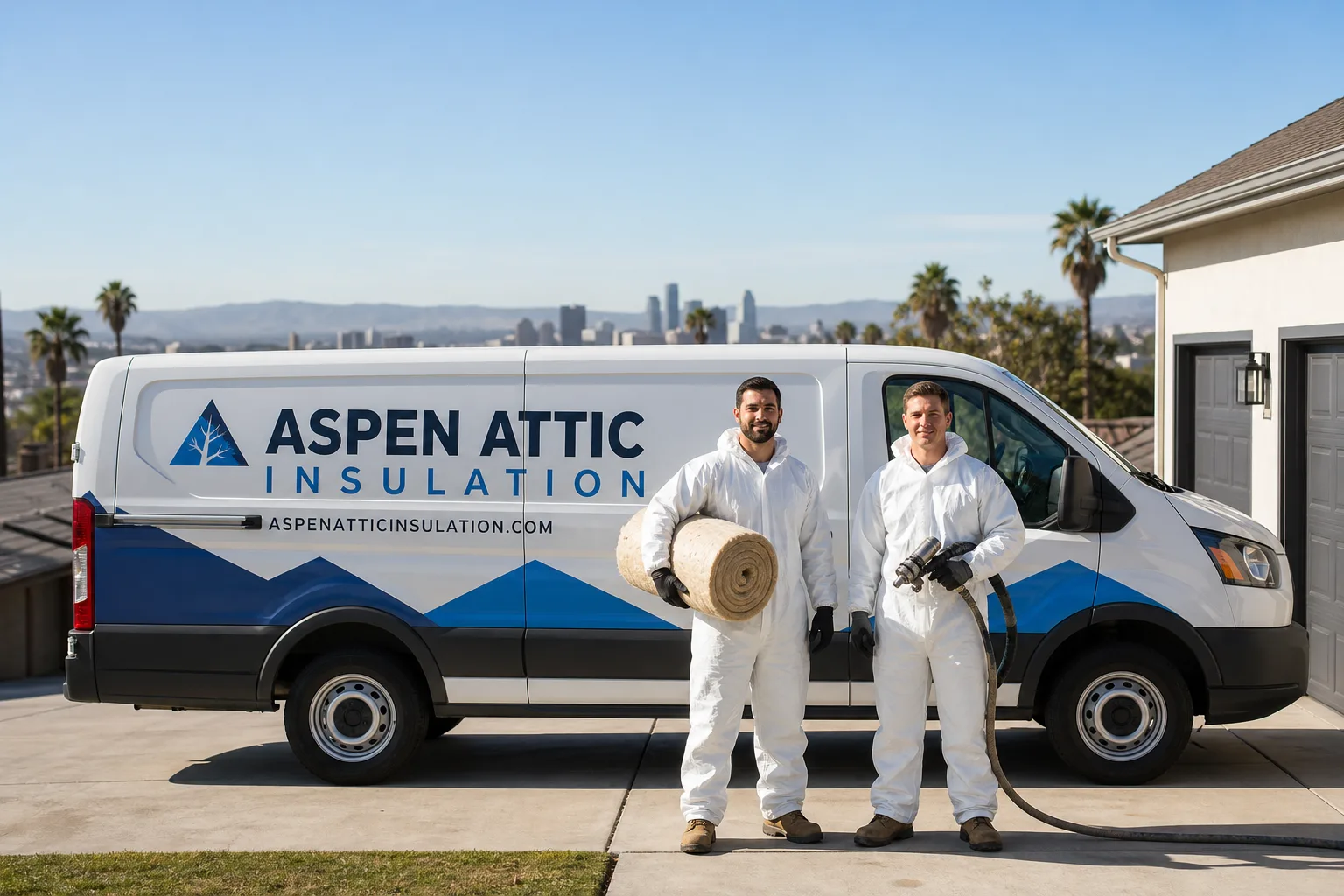
Fast, Reliable Spray Foam Insulation Across Acton
Spray foam insulation in Acton, CA typically costs $2.50 – $6.50 per square foot depending on open-cell or closed-cell application, and most projects are completed in one to two days. Because Acton sits in a CalFire Very High Fire Severity Zone, every installation must also satisfy ignition-barrier requirements that don’t apply in neighboring cities. That’s why Acton homeowners call Aspen Attic Insulation at (864) 428-1615 – we know the local codes, the high-desert climate, and the specific failure modes that hit ranch homes off Soledad Canyon Road and the custom builds near Sierra Highway.
Our crews serve Acton from our Los Angeles dispatch office, with scheduling coordinated for same-week availability in the 93510 ZIP code and surrounding areas. We’ve worked on the older ranches near Vasquez Rocks, the manufactured homes along Crown Valley Road, and the newer construction up toward Aliso Canyon. Every technician we send is background-checked, identity-verified, and photographed – you’ll get their name and image before anyone arrives at your door, because knowing who to expect matters, especially when you’re home alone or have young children.
Why Aspen Attic Insulation Is Acton’s Preferred Spray Foam Insulation Company
We’ve been part of the Threshold Group family since 2002, and every Aspen Attic Insulation location operates to the Threshold Verified standard. That means no anonymous crews, no post-job invoices, and no guesswork about who’s walking into your home. In Acton specifically, we’ve built our reputation on understanding what other companies miss: the dual requirement of fire-zone compliance and thermal performance in a high-desert environment.
Our 365-Day Done Right Promise covers every job in writing. If something fails, we come back free. We also deliver a written price before any work starts – every time, no exceptions. For Acton homeowners dealing with 100°F summer afternoons and winter lows in the 20s, that predictability matters. You can’t afford to have insulation that shrinks, delaminates, or leaves thermal bridges because someone cut corners on cure time or ignition barriers.
Calls to (864) 428-1615 are answered by a live person 24/7. No voicemail loops, no “we’ll call you back tomorrow” when your attic is hitting 140°F and your HVAC won’t stop running.
Spray Foam Wall Insulation in Acton
Spray Foam Wall Insulation in Acton is most often needed in the custom ranch homes built between the 1960s and 1990s, where original wall cavities were either empty or poorly insulated with thin fiberglass batts that settled decades ago. In Acton’s high-desert climate, those walls become thermal highways – hot air pours through in July, cold air seeps through in January, and the HVAC system never catches its breath. A typical open-cell wall application here runs $1.50 – $3.00 per square foot, while closed-cell for fire-zone exterior walls runs $3.00 – $6.50 per square foot, including the ignition-barrier covering required by local amendment.
When Walls Need It Most
We see the worst wall performance in homes near Soledad Canyon Road and the older ranches south of Sierra Highway, where 2×4 construction with minimal insulation was standard. If your interior walls feel hot to the touch in summer or your bedroom never holds temperature, the cavity is likely unsealed. Our Spray Foam Insulation team tests with thermal imaging before quoting, so you know exactly where the leaks are.
Open-Cell vs. Closed-Cell for Acton Walls
Open-cell works well for interior partition walls where fire separation isn’t required – it breathes, reduces sound, and fills irregular cavities at lower cost. Closed-cell is specified for exterior walls in Acton’s Very High FHSZ because of its higher density and Class I fire rating, though it still must be covered with an ignition barrier per local amendment. We don’t guess which you need; we check your wall assembly and the applicable code cycle.
Rim Joist Spray Foam in Acton
Rim Joist Spray Foam in Acton addresses one of the most overlooked leak paths in the area’s ranch and manufactured homes: the band joist where the foundation meets the first floor. In Acton’s older housing stock, these rim joists are often completely unsealed, letting desert wind, dust, and temperature extremes into the crawl space or basement perimeter. A typical rim joist treatment here runs $800 – $2,400 depending on linear footage and whether we use open-cell or closed-cell foam, with closed-cell required where the rim joist forms part of the home’s fire-resistance-rated envelope.
The Thermal Bypass Problem
We find rim joist gaps in nearly every 1970s and 1980s ranch we inspect in Acton. The original builders stuffed fiberglass into these cavities if they insulated them at all, and that fiberglass is now compressed, dirty, and bypassed by air moving through plumbing and wiring penetrations. Spray foam adheres directly to the wood, seals every gap, and adds structural rigidity – critical in an area where Santa Ana gusts test every weakness.
Manufactured Home Rim Joists
Acton has a significant manufactured-home population, and these structures often have exposed steel-frame rim areas that conventional insulation can’t address. We use closed-cell foam to bond dissimilar materials and prevent galvanic corrosion while creating a thermal break. It’s a detail many insulation contractors skip because they don’t stock the right products or understand manufactured-home assembly.
Trusted Brands We Service in Acton
We keep materials from Owens Corning, Johns Manville, and Knauf on hand for Acton jobs, matched to the specific assembly rather than forced from whatever’s in the truck. Owens Corning’s FOAMULAR rigid foam pairs with our spray foam systems in hybrid assemblies; Johns Manville mineral wool provides the ignition-barrier covering required over exposed foam in Very High Fire Severity Zones; and Knauf’s EcoSeal water-based sealant complements spray foam in complex attic geometries where full foam coverage isn’t practical. Because we source from eight industry-leading brands total – including Icynene, Demilec, and GreenFiber for specific applications – we don’t substitute mid-project. If your job spec calls for Rockwool over Icynene closed-cell, that’s what goes in.
Common Spray Foam Insulation Problems We See in Acton Homes
- Failed adhesion over old batts. Settled R-11 batts in original 1960s – 1990s ranch attics get bypassed by air leaks, and some contractors spray foam directly over this dirty, compressed fiberglass without removal. The foam can’t bond to dust and degraded paper backing, so voids form within months. We remove or encapsulate old insulation properly before application.
- Shrinkage from thermal cycling. Acton’s 40 – 50°F daily temperature swings stress improperly cured or thin spray foam, causing it to pull away from rafters and open thermal bridges. We specify minimum thicknesses and cure schedules calibrated for high-desert conditions, not coastal California norms.
- Exposed foam in fire zones. Santa Ana and desert gusts drive embers through standard gable and roof vents. If spray foam is left exposed without an ember-resistant vent screen or ignition barrier, the assembly is non-compliant for Acton’s Very High FHSZ and creates a real hazard. We install both barriers as standard practice here.
- Condensation from missing vapor management. The same diurnal swings that shrink poorly specified foam also create condensation at foam-to-wood interfaces when warm moist interior air hits cold sheathing. We calculate dew point location for each assembly and specify permeance accordingly.
Pricing for Spray Foam Insulation in Acton, CA
| Application | Material | Price Range (Acton) |
|---|---|---|
| Open-cell wall insulation | Icynene or equivalent | $1.50 – $3.00/sq ft |
| Closed-cell wall insulation | Demilec or equivalent | $3.00 – $6.50/sq ft |
| Rim joist treatment | Closed-cell | $800 – $2,400 total |
| Attic roof deck (open-cell) | Icynene | $2.50 – $4.50/sq ft |
| Attic roof deck (closed-cell + ignition barrier) | Demilec + Rockwool | $4.50 – $6.50/sq ft |
| Garage ceiling | Closed-cell + barrier | $3.00 – $5.50/sq ft |
What moves you within these ranges? Roof-deck access difficulty, whether old insulation removal is needed, and the ignition-barrier specification. A simple open-cell wall job in a gutted room costs less than a closed-cell roof deck where we’re working around existing HVAC and covering every exposed surface with mineral wool. Every homeowner receives a written price before any work starts – no post-job surprises, no “we found something extra.” Call (864) 428-1615 for a free estimate with exact numbers for your home.
We Also Serve Cities Near Acton
Our crews regularly work in Acton and the surrounding high-desert communities, including Palmdale to the north, Lancaster in the Antelope Valley, Santa Clarita to the southwest, and San Fernando to the south. Each shares some of Acton’s climate challenges, but only Acton carries the CalFire Very High Fire Severity Zone designation that shapes our ignition-barrier specifications. If you’re unsure whether your property falls in the FHSZ, we check during the estimate and quote accordingly.
Serving Acton, CA - Our Local Coverage Area
We’re based in the Acton area and know this community well. Use the map below to see our service coverage - if you’re nearby, we can almost certainly help.
FAQs About Spray Foam Insulation in Acton
Yes. Acton’s CalFire Very High Fire Severity Zone requires that exposed spray foam be covered with an ignition barrier such as mineral wool or fire-rated gypsum. We install Rockwool mineral wool over closed-cell foam in attics and roof decks as standard practice here, a step we discuss with Acton homeowners far more than with clients in Santa Clarita or Palmdale. Call (864) 428-1615 and we’ll verify your property’s FHSZ status during the free estimate.
No – not if the batts are dirty, compressed, or degraded. Spray foam needs a clean, dry substrate to bond properly. We were called to a custom ranch off Soledad Canyon Road where the original R-11 batts in the vented attic had settled to about R-6 under a 100°F+ summer load and 25°F winter lows. We removed the old material, air-sealed the top plates, applied closed-cell spray foam along the rim joists and knee walls using Icynene, then covered the exposed foam with Rockwool mineral wool to meet the WUI ignition-barrier expectation. The homeowner saw an immediate reduction in afternoon attic temperatures and the HVAC short-cycling they’d dealt with for years. Every job starts with an honest assessment of what’s salvageable and what must go.
The 40 – 50°F daily swings in Acton stress improperly cured foam and can cause thin applications to shrink and delaminate. Closed-cell foam handles this cycling better due to its higher density and rigidity, which is why we specify it for roof decks and exterior applications in Acton. Open-cell works for interior walls where temperature differentials are moderated by conditioned space. We match the product to the assembly and the local climate, not a one-size-fits-all national spec.
Yes. Local technicians know that Acton’s frequent high winds drive embers into attic vents during fire season, so we install ember-resistant vent screens as part of our standard fire-zone protocol – even when not strictly required by code for the specific assembly. It’s a practice rarely seen in nearby non-WUI cities, and it’s part of how we protect the insulation investment you’ve made. The screens are specified in your written quote, not added later.
We primarily use Icynene for open-cell applications and Demilec for closed-cell in Acton, paired with Rockwool mineral wool for ignition barriers. Owens Corning and Johns Manville materials supplement hybrid assemblies where rigid board or batt integration improves performance. We don’t force whatever’s in the truck; we match the brand and product to your specific assembly, climate exposure, and code requirements. Call (864) 428-1615 for a free estimate – we’ll explain exactly what goes where and why.
Written by Garrett Sloane, Owner at Aspen Attic Insulation, serving Acton and the greater Los Angeles County high desert.