
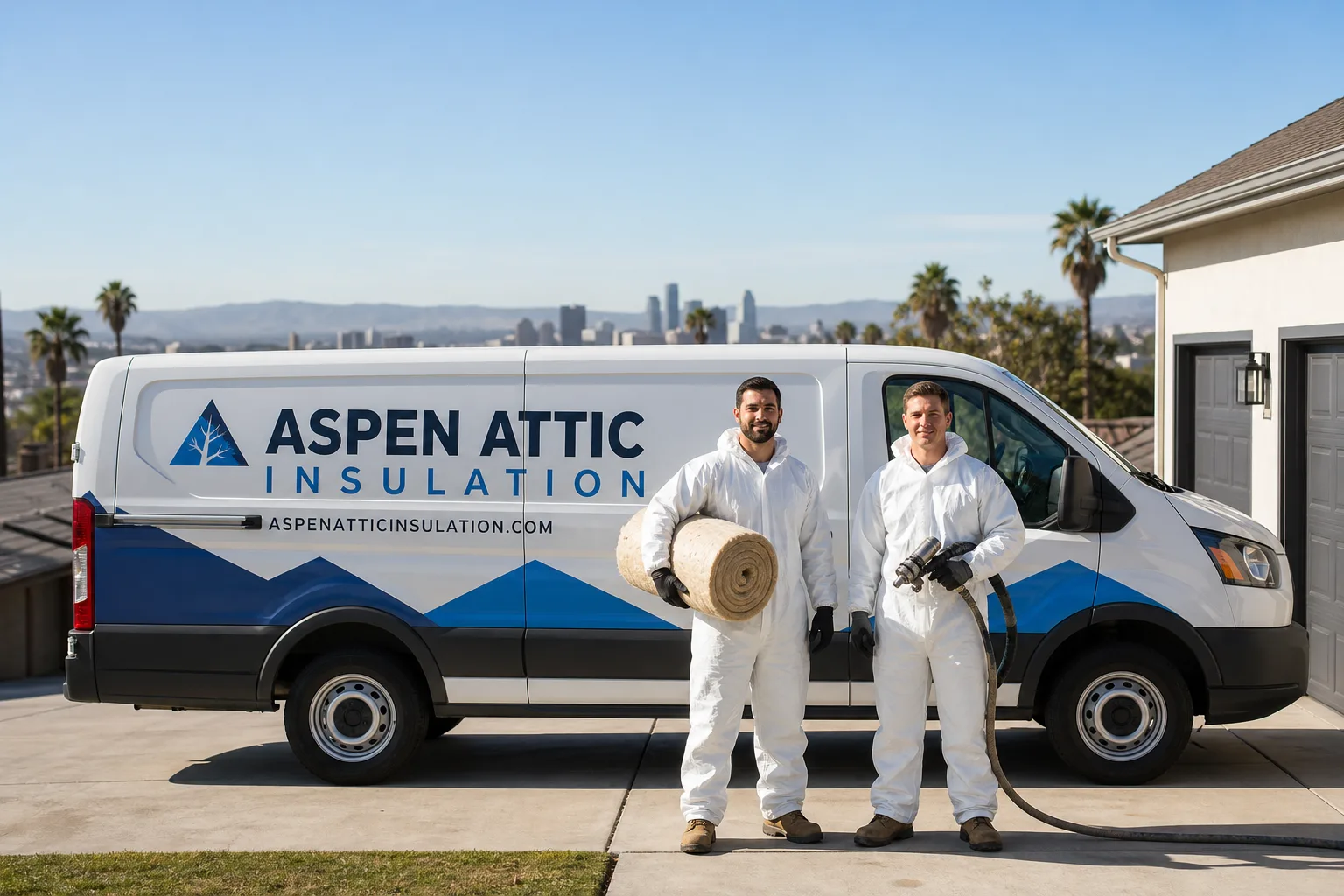
Fast, Reliable Blown In Insulation Across Blythe
Blown-in insulation in Blythe typically costs $1.20 – $2.80 per square foot installed, with most single-story homes running $1,800 – $4,200 for a complete attic fill. We’re usually on-site within 24 – 48 hours, and every job starts with a written price before any work begins. Call (864) 428-1615 for a free estimate.
We’ve worked in Blythe long enough to know the difference between a quick top-off and a proper fix. Your 1950s – 1980s stucco home on a flat or low-pitch roof wasn’t built for 110°F summers and roof decks that hit 160°F by mid-July. The original R-11 batt insulation in your vented attic has likely compressed into a thin mat under decades of wind-driven desert dust, and your HVAC is paying the price. That’s why our Blown In Insulation team maps every attic before we blow a single bag. We check where insulation has thinned below R-11, where roof-deck temps spike highest, and where dust infiltration has contaminated what remains. Dispatch and scheduling for Blythe jobs are coordinated from our Los Angeles office, but the crew that shows up at your door knows Palo Verde, the neighborhoods along Hobsonway, and the specific headache of cooling a 1960s stucco box in August.
Why Aspen Attic Insulation Is Blythe’s Preferred Blown In Insulation Company
Garrett Sloane built this operation on a simple idea: homeowners should know exactly who’s coming through their door and exactly what they’ll pay before anyone touches their attic. In Blythe, that matters more than most places. You’re often home alone during the day, dealing with triple-digit heat, and the last thing you need is a stranger who won’t show ID or a bill that materializes after the work is done.
Every Aspen technician is background-checked, identity-verified, and arrives in a clean marked uniform with a photo ID badge. We send you the tech’s name and photo before the visit. If anyone else shows up, the visit is free and we make it right. That’s The Threshold Standard, and it applies to every Blythe job we run.
Our 365-Day Done Right Promise covers every repair in writing for a full year. If something fails, we come back free. No call-back windows, no voicemail loops. A live person answers our phone 24/7.
We’ve earned a strong local reputation in Blythe by treating the specific problems this desert town throws at attics: thermal settling under extreme heat, wind-driven dust contamination, and flat-roof heat trapping that generic insulation crews from cooler climates simply don’t recognize.
Cellulose Insulation in Blythe
Cellulose Insulation in Blythe is our most common blown-in request, and for good reason. Machine-fed loose fibers of recycled paper treated with borate fire retardant, cellulose fills every gap in your attic cavity and delivers R-3.2 to R-3.8 per inch. For a typical 1,200-square-foot Blythe attic, you’re looking at $2,100 – $3,800 for a complete fill to R-38, including air-sealing prep. We use this when the existing insulation is too degraded to salvage, when we need to fill irregular joist bays in older homes, or when homeowners want a green material that handles our dry climate well.
When Cellulose Beats Other Options
Blythe’s vented attics with blown-in cellulose perform better than fiberglass batts in irregular cavities, and the material’s density helps block wind-driven dust when we pair it with proper soffit baffling. We see the biggest wins in 1960s – 1970s stucco homes near the Colorado River, where original batts have compressed to nothing and the joist bays are anything but uniform.
Fire Safety and Desert Conditions
The borate treatment in our GreenFiber cellulose resists both fire and pests, which matters in Blythe’s dry environment where rodent activity in vented attics isn’t rare. Unlike some spray foams, cellulose won’t off-gas in 160°F attic conditions, and it maintains its R-value across our temperature swings.
Blown In Attic Insulation in Blythe
Blown In Attic Insulation in Blythe is what most homeowners actually need, whether they call it that or not. The job involves removing or working around existing degraded material, sealing air leaks at top plates and penetrations, installing baffles to block wind-driven dust at vented soffits, then machine-blowing new insulation to the depth that hits your target R-value. For Blythe’s climate, that’s typically R-38 to R-49, which means 10 – 14 inches of cellulose or 12 – 15 inches of fiberglass. A full attic redo on a 1,400-square-foot Blythe home runs $2,400 – $4,500.
Air Sealing Before Blowing
We never blow new insulation over a leaky attic. In Blythe’s older homes, unsealed top plates and recessed light housings let conditioned air escape straight into the vented cavity, and wind pressure pushes that hot desert air right back in. Our crews spend the first hour sealing with caulk and foam before the blower truck starts.
Depth Mapping for Flat Roofs
Flat and low-pitch roofs common in Blythe neighborhoods near Hobsonway and along the I-10 corridor trap heat against the deck. We use thermal imaging to map hot spots, then vary blown-in depth to compensate, sometimes hitting 16 inches in the worst zones. Generic crews who blow to a uniform depth miss these critical variations.
Trusted Brands We Service in Blythe
We stock materials from eight industry-leading brands, and for Blythe’s specific conditions we most often reach for GreenFiber cellulose, Owens Corning fiberglass loose-fill, and Johns Manville mineral wool. Each has a place depending on your roof type, existing conditions, and whether we’re dealing with dust contamination or bare joists. Keeping these materials on hand means no waiting for special orders when your attic is hitting 140°F and your AC won’t cycle off. Our crews carry the right product for your specific job, not whatever was left on the truck from yesterday’s call.
Common Blown In Insulation Problems We See in Blythe Homes
- Compressed R-11 batts turned to dust mats. The original insulation in 1950s – 1980s Blythe stucco homes was barely adequate when installed. After forty years of 160°F roof-deck heat and dust infiltration, it’s a 2 – 3 inch compressed layer with an effective R-value under R-5. Topping this off without removal traps the degraded material and its dust load against your ceiling.
- Wind-driven dust burying blown-in cellulose. Blythe’s vented attics along the Colorado River corridor take steady wind pressure. Without proper soffit baffles, dust infiltrates and buries cellulose fibers, reducing loft and cutting effective R-value by 20 – 30% within five years. We see this most in homes near the agricultural zones west of town.
- Flat-roof heat trapping with undersized depth. Low-pitch and flat roofs common in central Blythe neighborhoods put the roof deck closer to your living space. Blown-in depth that’s adequate for a pitched roof in a cooler climate fails here. We’ve measured attic air temps of 145°F in homes with “properly” insulated 8-inch cellulose fills because the depth didn’t account for radiant heat gain.
- Failed HVAC from short-cycling. When attic heat gain overwhelms your insulation, the compressor runs nonstop from noon to sunset. We were called to a 1962 single-story stucco home near Palo Verde Community College where the original R-11 batt was compressed into a 3-inch mat under decades of dust, and the homeowner’s HVAC was short-cycling by 2 p.m. every July. After sealing the top plates and baffling the vented soffits against wind-driven dust, we machine-fed GreenFiber cellulose to R-38 and registered a 14°F drop in the attic’s peak afternoon temperature reading.
Pricing for Blown In Insulation in Blythe, CA
A typical blown-in insulation job in Blythe runs $1,800 – $4,500 for residential attics, depending on square footage, existing material condition, and whether we need to remove degraded insulation before installing new. Cellulose runs $1.20 – $1.90 per square foot; fiberglass loose-fill ranges $1.40 – $2.20; mineral wool for specific fire or sound applications hits $2.20 – $2.80. Removal of old, contaminated material adds $0.50 – $1.10 per square foot. Air sealing, soffit baffling, and radiant barrier installation are priced separately based on attic complexity.
What drives cost up: extensive dust contamination requiring full removal, multiple attic hatches or complex framing, flat roofs needing extra depth, and homes with active rodent issues requiring cleanup. What keeps cost down: accessible attics, salvageable existing insulation we can top off, and straightforward rectangular layouts common in 1970s tract homes.
Every homeowner receives a written price before any work starts. No post-job surprises, no “while we were up there” add-ons. Call (864) 428-1615 for your free estimate.
We Also Serve Cities Near Blythe
Our crews run regular routes to Mecca, Coachella, Twentynine Palms, and Indio for blown-in insulation jobs. If you’re in the eastern Coachella Valley or along the Colorado River corridor and your attic can’t handle another summer, we cover your area too. Blythe remains our core desert market, but the same Threshold Verified technician protocols and 365-Day Done Right Promise travel with us to every nearby city.
Serving Blythe, CA - Our Local Coverage Area
We’re based in the Blythe area and know this community well. Use the map below to see our service coverage - if you’re nearby, we can almost certainly help.
FAQs About Blown In Insulation in Blythe
A 1960s Blythe stucco home needs 10 – 12 inches of blown-in cellulose or 12 – 14 inches of fiberglass loose-fill to achieve R-38, assuming we’ve air-sealed first and installed proper soffit baffles. Flat-roof homes may need 14 – 16 inches in hot zones near the roof deck. Call (864) 428-1615 and we’ll measure your specific attic.
Yes, when installed with proper depth and dust protection. The borate fire retardant in GreenFiber cellulose doesn’t degrade in dry heat, and the material maintains R-value across our temperature range. The key is preventing wind-driven dust from infiltrating and settling into the fibers, which we address with sealed soffit baffles on every Blythe job.
Most Blythe homes built 1950s – 1980s started with R-11 or less, and decades of 160°F roof-deck heat plus wind-driven dust have compressed or contaminated that original material. Topping off traps the degraded layer underneath, reducing overall performance and potentially spreading dust into your living space. We remove what’s failed, then blow new material to full depth.
No. A radiant barrier reduces radiant heat transfer from the roof deck but does nothing to stop conductive heat flow through the attic floor or convective leaks through gaps. In Blythe’s flat-roof homes, we use radiant barriers as a supplement to, not replacement for, blown-in insulation at R-38 or higher. The combination is what drops attic temperatures meaningfully.
Wind-driven dust settles into cellulose fibers, reducing loft and cutting effective R-value by 20 – 30% over five to seven years. In Blythe’s agricultural and river-corridor zones, this happens faster than in sealed attic markets. We prevent it with properly installed soffit baffles that block dust while maintaining ventilation, a step many generic crews skip.
Written by Garrett Sloane, Owner at Aspen Attic Insulation, serving Blythe and the eastern Coachella Valley. Every job carries a written price before work begins and is backed by our 365-Day Done Right Promise. Call (864) 428-1615 for a free estimate.