
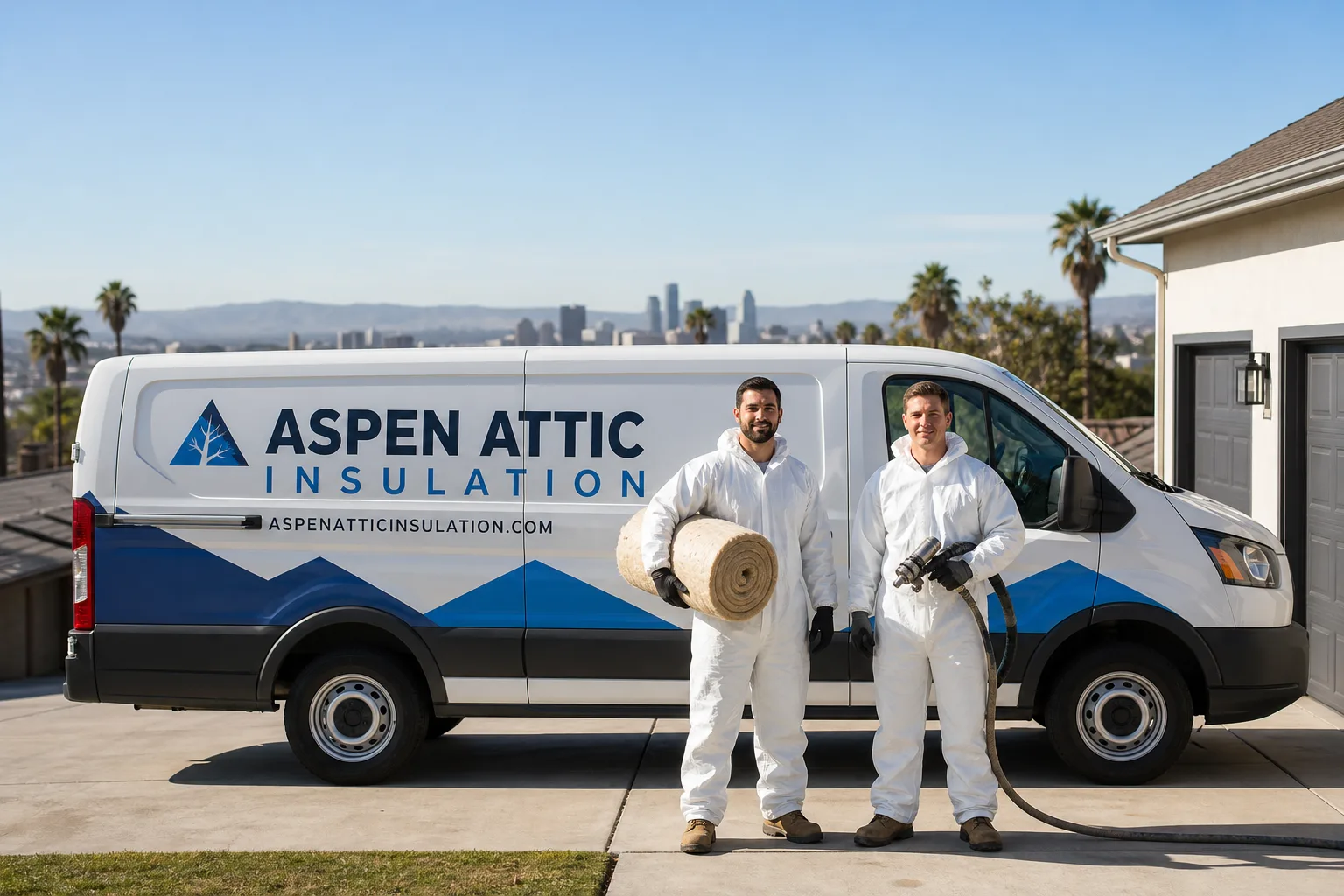
Fast, Reliable Blown In Insulation Across Apple Valley
Blown in insulation in Apple Valley typically costs $1.80 to $3.20 per square foot installed, with most attic retrofits running $2,400 to $4,800 for a standard 1,200-square-foot home. Most Apple Valley jobs are completed in a single day, and our crews are dispatched from our Inland Empire office with same-week scheduling available. Call (864) 428-1615 for a free written estimate.
We know Apple Valley’s housing stock. The post-1980 tract homes off Bear Valley Road, the manufactured homes near the Mojave River wash, and the ranch-style houses spread across the large lots north of Central Road – we’ve worked in attics across all of them. Our Blown In Insulation team understands how this high-desert climate at roughly 3,000 feet elevation punishes insulation that would perform adequately just 30 minutes down the hill in the Inland Empire. Apple Valley’s 100°F summer afternoons and 20°F winter nights create a temperature swing that crushes standard fiberglass batts and demands a different approach: higher R-values, proper air sealing, and radiant-barrier integration.
Why Aspen Attic Insulation Is Apple Valley’s Preferred Blown In Insulation Company
We’ve built our reputation in Apple Valley on one thing: showing up as promised, with the technician’s name and photo already sent to the homeowner’s phone. Every tech is background-checked, identity-verified, and arrives in a clean marked uniform with a photo ID badge. If anyone else shows up at your door, the visit is free and we make it right. That’s The Threshold Standard, and it applies to every Apple Valley home we enter.
Our crews serve Apple Valley directly from the Inland Empire dispatch hub, which means we’re not driving from Los Angeles or Orange County and billing you for the windshield time. We know the local building environment: the 2022 California Energy Code requirements, the common rodent-damage patterns in attics near the desert edge, and how the afternoon sun hits roof decking on west-facing ranches across the Apple Valley foothills. Reviews from Apple Valley customers consistently mention our punctuality and the written price delivered before any work starts – no post-job surprises, ever.
Every job carries our 365-Day Done Right Promise in writing. If the insulation settles, if a repair fails, or if something isn’t performing as quoted, we come back free and fix it. That guarantee covers labor and materials for a full year, and it’s not a verbal promise – it’s on the paperwork you sign.
Blown In Fiberglass Insulation in Apple Valley
Blown In Fiberglass Insulation in Apple Valley involves loose fiberglass fibers blown through a hose into your attic cavity, filling gaps around joists, top plates, and recessed lighting housings that batts leave exposed. In Apple Valley’s climate, this matters because those gaps become thermal highways during summer’s 100°F-plus afternoons and winter’s below-freezing lows. A typical blown-in fiberglass retrofit in Apple Valley runs $2,200 to $4,200 for attics between 1,000 and 1,500 square feet, with larger homes or those requiring old-batt removal trending toward the higher end.
Most Apple Valley homeowners need blown-in fiberglass when their existing insulation has compressed below R-19, when they’re adding air conditioning to a home that previously relied on evaporative cooling, or when energy bills spike during July and August despite the thermostat staying constant. The 1980s and 1990s tract homes common south of Bear Valley Road are prime candidates – their original batts were often installed at minimum code and have degraded significantly.
Matching Material to the Job
We stock Owens Corning PINK Fiberglas loose fill and Knauf Jet Stream Ultra for Apple Valley installations. Owens Corning performs well in high-heat attics where summer roof decking exceeds 140°F, while Knauf’s low-dust formula suits homeowners with respiratory sensitivities. We don’t bring one product and force it to fit. We test existing insulation depth, check for moisture or rodent contamination, and specify the right material in the written quote.
Air Sealing Before Blowing
Blown-in fiberglass only works if the attic floor is sealed first. Our crews caulk top plates, seal recessed can lights with rated covers, and foam-penetrate wire and plumbing penetrations before the blower truck arrives. In Apple Valley, skipping this step means your new R-38 performs like R-25 within two seasons. We include air sealing in every blown-in quote – it’s not an upsell, it’s the job.
Loose Fill Insulation in Apple Valley
Loose Fill Insulation in Apple Valley refers to cellulose or fiberglass fibers blown dry into attic cavities to achieve uniform coverage without the seams and compression points of batt installation. For Apple Valley’s large-lot ranch homes and manufactured housing, loose fill is often the only practical way to insulate irregular joist bays, perimeter eaves, and dropped soffits that batts can’t reach. Typical loose-fill installation in Apple Valley runs $1.80 to $3.00 per square foot, with cellulose trending lower and fiberglass trending higher due to material cost differences.
Apple Valley homeowners should consider loose fill when their attic has complex geometry – multiple ceiling heights, ductwork running through the space, or additions built at different times with different joist spacing. The 1980s and 1990s housing stock throughout the Victor Valley area is notorious for inconsistent original insulation, and loose fill levels those differences in a single application.
Cellulose vs. Fiberglass Loose Fill
We install GreenFiber cellulose and Johns Manville fiberglass loose fill in Apple Valley attics. Cellulose offers higher R-value per inch and performs well in the dry desert climate where moisture concerns are minimal. Johns Manville fiberglass doesn’t settle as aggressively over time, which matters in attics where homeowners plan to store items on the insulation surface. We explain the tradeoffs in the written quote and let the homeowner decide – no default product pushed for inventory convenience.
Addressing Perimeter Drift
In Apple Valley’s wind-exposed locations, loose fill can drift toward the center of the attic over time, leaving the outer eaves thin. Our crews install baffles at the soffit vents and use slightly higher density at the perimeter to counter this. It’s a local technique we’ve developed after seeing too many Apple Valley attics with cold spots at the exterior walls every January.
Trusted Brands We Service in Apple Valley
We maintain stock from eight industry-leading brands – Owens Corning, Johns Manville, Knauf, Rockwool, CertainTeed, Icynene, Demilec, and GreenFiber – with core blown-in materials kept on hand at our Inland Empire warehouse for Apple Valley jobs. For blown-in work, we most commonly specify Owens Corning and Knauf fiberglass loose fill, with Johns Manville and GreenFiber available for homeowners requesting specific performance characteristics. Rockwool and CertainTeed enter the conversation when fire resistance or sound attenuation matters, though in Apple Valley’s dry climate those concerns are secondary to thermal performance. Having multiple brands ready means we don’t substitute without homeowner approval, and it keeps our turnaround tight – most Apple Valley attics are insulated within a week of the estimate.
Common Blown In Insulation Problems We See in Apple Valley Homes
- Crushed R-19 batts performing at R-8 or lower. In many Apple Valley homes, the 1980s-90s fiberglass batts in the attic have been crushed by decades of hot, dry air and rodent activity, so the heating and cooling systems work overtime during the 100°F+ summers and freezing winter nights. Our crews remove this debris, sanitize the attic floor, and blow new material to proper depth.
- Settled loose fill in perimeter corners of ranch and manufactured-home attics. Wind-driven desert dust and natural drift leave the outer edges under-insulated, creating cold spots at exterior walls during winter’s below-freezing lows. We spot-check depth across the entire attic footprint, not just the center, and redistribute or add material where needed.
- Radiant heat gain overwhelming bulk insulation alone. Unshielded roof decking in Apple Valley attics can hit 140°F, and even R-49 blown-in material can’t stop that infrared energy from radiating downward. We evaluate whether radiant-barrier foil or reflective roof decking belongs in your assembly – it’s a common Apple Valley upgrade that many insulation contractors skip.
- Top plates and recessed cans left unsealed during original construction. In the tract homes built during Apple Valley’s 1980s-90s growth boom, builders often blew insulation batts into place without sealing the attic floor first. Warm air escapes upward all winter, and superheated attic air infiltrates downward all summer. Our air-sealing step closes these pathways before new loose fill goes in.
Pricing for Blown In Insulation in Apple Valley, CA
A typical blown-in insulation retrofit in Apple Valley runs $2,200 to $4,800 for attics between 1,000 and 1,500 square feet, with costs scaling roughly $1.80 to $3.20 per square foot depending on material choice and prep work needed. Homes requiring removal of contaminated old insulation add $0.60 to $1.10 per square foot for disposal and sanitation. Radiant-barrier installation, when recommended for Apple Valley’s high solar gain, runs $1.20 to $2.00 per square foot additional.
What moves the needle: attic accessibility (steep roof pitches or limited hatch access add labor), existing insulation condition (rodent contamination requires full removal), and whether air sealing is extensive. We don’t guess at these factors over the phone. Every Apple Valley estimate includes a free attic inspection, a written line-item price, and the technician’s name and photo sent to you before the visit. Call (864) 428-1615 to schedule – estimates are free, and there’s no obligation to proceed.
We Also Serve Cities Near Apple Valley
Our crews work throughout the Victor Valley and surrounding high desert. We regularly insulate homes in Hesperia, Victorville, Adelanto, and Lucerne Valley – each with its own climate and housing-stock considerations, though none match Apple Valley’s specific 3,000-foot elevation and temperature swing. If you’re in any of these communities and need Blown In Insulation in Apple Valley-level expertise applied to your attic, we cover the full region.
Serving Apple Valley, CA - Our Local Coverage Area
We’re based in the Apple Valley area and know this community well. Use the map below to see our service coverage - if you’re nearby, we can almost certainly help.
FAQs About Blown In Insulation in Apple Valley
Apple Valley sits roughly 3,000 feet above sea level, and that elevation drives faster overnight radiative cooling than Victorville or Hesperia experience. A crushed, settled R-19 batt attic – the default in many 1980s – 90s tract and ranch homes – can’t hold warmth by morning, so the furnace re-fires against a 20°F outdoor low before the sun even clears the Ord Mountains. The daily temperature swing here is larger, which means insulation has to work harder in both directions. Call (864) 428-1615 for a free assessment of whether your attic is keeping up.
Yes, in nearly every case we’ve seen across Apple Valley. Those original batts have been compressed by 140°F attic heat, rodent traffic, and decades of dust accumulation, often performing at half their labeled R-value or less. Blown-in material fills every joist bay uniformly, eliminates the gaps between batts, and can be layered to R-38 or R-49 where code and climate demand it. We remove the old material, sanitize, air-seal, and blow new – it’s the standard approach for Apple Valley’s housing vintage. Call (864) 428-1615 for a written quote on your specific attic.
We recommend an attic inspection every 5 to 7 years in Apple Valley, or sooner if energy bills spike, rooms develop uneven temperatures, or you notice HVAC running longer than usual. The high-desert environment accelerates degradation: thermal cycling between 20°F and 140°F stresses materials, and wind-blown dust can settle on insulation surfaces, reducing effectiveness. Our inspections are free and include depth measurements, contamination checks, and a written condition report. Call (864) 428-1615 to schedule.
No, not always. Blown-in insulation addresses conductive heat transfer – heat moving through solid materials – but Apple Valley’s unshielded roof decking can hit 140°F and radiate infrared energy straight through even R-49 material. For some homes, spray foam insulation in Apple Valley may be worth considering instead. In a 1989 ranch home off Central Road near the Mojave River wash, our crew opened an attic holding collapsed R-19 fiberglass batts that had been trampled into the joist bays by two decades of rodent runs and 140°F summer attic heat. After air-sealing the top plates and recessed cans, we blew Owens Corning PINK Fiberglas loose fill to roughly R-49, then set and stapled R-38 reflective radiant-barrier foil across the underside of the roof rafters to cut the afternoon radiant load. The homeowner’s July-afternoon thermostat recovery time dropped noticeably on the first 100°F day after the install. We evaluate radiant-barrier need during every Apple Valley estimate. Call (864) 428-1615 to discuss your attic.
Sometimes, but only after we verify the existing material is clean, dry, and not compressed below recoverable levels. In Apple Valley, we often find that 1980s-90s batts are too far gone – crushed to R-8, contaminated with rodent waste, or interwoven with dust that prevents new material from bonding properly. When the existing insulation is salvageable, we’ll air-seal the attic floor and blow new loose fill on top to reach target R-value. If it’s not, removal and full replacement is the only honest recommendation. We tell you which category you’re in during the free inspection, with photos and a written quote either way. Call (864) 428-1615 to find out where your attic stands.
Ready to stop overpaying for heating and cooling in a house that bakes by day and chills by night? Call Aspen Attic Insulation at (864) 428-1615 for a free, written estimate on blown-in insulation for your Apple Valley home. We’ll send you the technician’s name and photo before anyone arrives, and you’ll have our 365-Day Done Right Promise in writing before any work begins.
Written by Garrett Sloane, Owner at Aspen Attic Insulation, serving Apple Valley and the high desert since 2002.