
Spray Foam Insulation: Repair or Replace? How Los Angeles Homeowners Decide
Spray foam insulation repair in Los Angeles costs $400 to $1,800 in most cases, while full removal and replacement runs $4,000 to $15,000 depending on attic size and foam type. The honest answer: small surface cracks and minor shrinkage can usually be patched, but delamination, discoloration, or moisture trapped beneath the foam means it has to come out. If you’d rather not sort through the diagnosis yourself, call us at (864) 428-1615 and we’ll send a technician who can tell you which side of that line you’re on.
Spray foam is unlike any other insulation product you can put in a Los Angeles home. Fiberglass batts sag, you add more. Blown-in settles, you top it off. Spray foam either bonds to the surface or it doesn’t. When it doesn’t, the failure isn’t cosmetic. It’s structural, and it gets worse the longer it sits.
Why Spray Foam Fails Differently Than Other Insulation
Fiberglass and cellulose fail gradually. You lose R-value a little at a time, the house feels draftier, the utility bill creeps up. Spray foam fails suddenly and visibly. It pulls away from the roof deck or wall sheathing, leaving gaps that channel moist air directly against wood. Because foam is an air barrier as much as an insulator, its failure means two systems broke at once.
In Los Angeles, we see the same failure pattern repeat across neighborhoods from Echo Park to Woodland Hills. Closed-cell foam that was applied too thin, or open-cell foam installed without the vapor retarder the assembly needed, or foam sprayed over dusty or damp wood that never should have been sprayed in the first place. The installation mistakes are specific. The consequences are specific too: condensation inside the roof cavity, wood rot you can’t see until the foam comes down, and a repair scope that grows with every square foot exposed.
The key takeaway: you’re not evaluating insulation performance. You’re evaluating whether the foam is still bonded, still dry, and still doing its job as an air barrier. That’s a different checklist than you’d use for any other insulation type.
The Tests That Tell You Whether Spray Foam Can Be Repaired
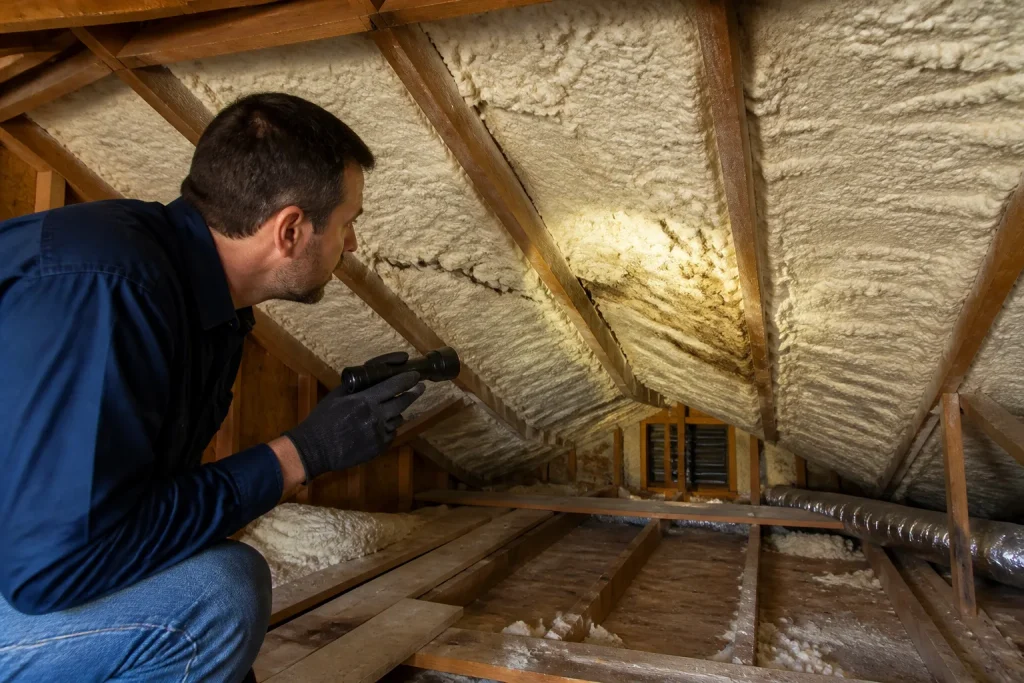
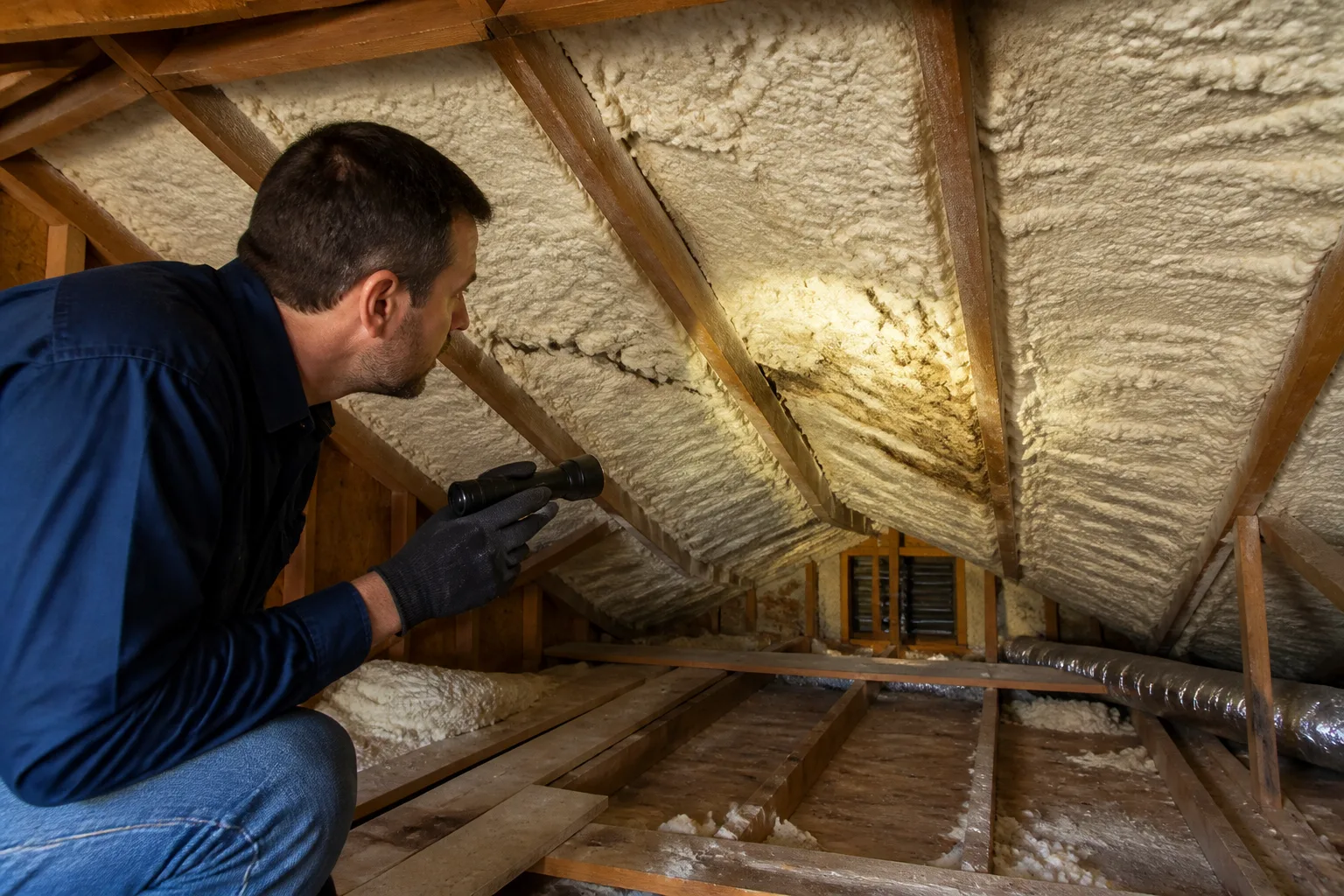
Before anyone quotes you a repair, someone needs to get in the attic and touch the foam. Not look at photos of it. Touch it. Here’s what distinguishes repairable foam from foam that has to be removed completely.
Repairable conditions
- Surface shrinkage cracks – small gaps where the foam pulled back from itself, not from the wood. These can be filled and sealed.
- Minor separation at edges – foam pulling away from a rafter or joist in isolated spots, usually from installation over dust or debris. The affected section can be cut out and re-sprayed.
- Small voids or missed areas – a spot the installer missed, typically under eaves or around framing. A targeted spray fixes it.
- Surface discoloration from UV or dust – cosmetic only. If the foam is otherwise bonded and dry, leave it alone.
Conditions requiring replacement
- Delamination – foam pulling away from the roof deck in sheets, not spots. This means the bond failed across a wide area.
- Color change to dark brown or black – indicates moisture saturation. The foam is holding water against the wood.
- Moisture felt beneath the foam layer – press on it. If it feels wet or spongy where it meets the sheathing, the roof deck has been wicking moisture.
- Brittle or crumbling foam – closed-cell foam should be dense and firm. If it crumbles under finger pressure, the chemical reaction didn’t cure properly.
- Musty or sour odor in the attic – not always the foam itself, but in an unvented LA attic, decaying foam backing or wood rot behind it is a frequent source.
Here’s the rule of thumb we use in the field: if the problem is in the foam, you can often repair it. If the problem is where the foam meets the wood, you’re usually looking at removal. Moisture on the back side of foam is not repairable. It’s a do-over.
Open-Cell vs. Closed-Cell: Why the Type of Foam Changes Everything
Around half the spray foam repair calls we run in Los Angeles involve open-cell foam that should have been closed-cell, or open-cell foam installed without the vapor management the roof assembly needed. This matters because the two products fail in completely different ways.
Open-cell foam is spongy and vapor-permeable. It lets moisture pass through it. Closed-cell foam is rigid and vapor-impermeable. It blocks moisture. In an unvented attic in Los Angeles, where warm moist interior air can hit a cold roof deck during winter nights, that difference determines whether condensation forms inside the assembly.
Here’s the problem we see over and over in LA: a contractor sprays open-cell foam directly against a roof deck with no vapor retarder, no ventilation gap, and no moisture calculation for the specific roof assembly. The foam lets moisture reach the sheathing. The sheathing can’t dry. The wood stays damp. Within a few years, especially in coastal neighborhoods like Playa del Rey or San Pedro where humidity runs higher, the roof deck shows rot.
Adding more open-cell foam on top of that mess fixes nothing. It’s not an R-value problem. It’s a moisture pathway problem. The foam has to come out, the deck has to be inspected and likely repaired, and the new foam has to be specified correctly for the assembly. That’s the repair-versus-replace calculus in a nutshell for open-cell failures.
Closed-cell foam failures are simpler in some ways. The foam doesn’t usually absorb moisture, but it can pull away from the deck if it was sprayed over dusty or damp wood, or if the roof has been leaking. The delamination creates air gaps, which creates condensation, which creates rot behind the foam. The foam itself might be fine. The bond is not.
Before any spray foam repair in Los Angeles, someone has to determine what type of foam is in your attic and whether it’s still functioning as designed. At Aspen Attic Insulation, we identify the foam type during the pre-work assessment and tell you what it means for your repair options. We source foam from manufacturers like Icynene and Demilec, but the brand matters far less than the chemistry and the installation detail.
The Roof Deck Inspection That Must Happen Before Any Spray Foam Repair in Los Angeles
This is the part that separates a real spray foam assessment from a sales visit. Before you let anyone patch or replace foam in your attic, the roof deck beneath it has to be inspected. Not glanced at. Inspected.
Here’s why. Spray foam is an air barrier and a vapor retarder (in the case of closed-cell). It hides the roof deck completely. If water has been getting behind the foam, whether from a roof leak, condensation, or a failed bond channeling moisture, the wood is rotting where you can’t see it. You won’t know until someone peels back a section of foam.
The inspection sequence we follow on every spray foam repair job in Los Angeles goes like this:
- Visual survey of the foam surface – looking for cracks, discoloration, delamination, and texture changes.
- Hand-pressure test – pressing on the foam to feel for movement, sponginess, or moisture at the bond line.
- Targeted foam removal – cutting a test section, usually one to two square feet, to expose the sheathing.
- Moisture meter reading on exposed wood – anything above 20% moisture content in Los Angeles framing means active moisture intrusion.
- Roof deck visual inspection – looking at the wood grain, nail lines, and any staining for rot, mold, or previous water intrusion.
Skipping step three through five is how a $600 patch job in Sherman Oaks turns into a $14,000 roof replacement in Encino three years later. The foam looked fine from above. The wood was not fine beneath it.
We pulled a garage spray foam job apart over in Silver Lake last year where the owner had paid another company to “fix” an area of delaminated foam. The previous contractor sprayed new foam directly over the old, uneven surface. The new foam bonded to the old foam in some places and to exposed wood in others. Six months later, water had found its way through the gaps between those two bond planes. The whole section had to be removed. It was still under the one-year mark at the time, but the original company refused to come back.
Getting an Independent Assessment: Building Envelope Consultant vs. Insulation Contractor
When the scope of a spray foam problem is genuinely uncertain, the person who sells spray foam is not the person who should be deciding whether it gets repaired or replaced. We say this as insulation contractors. The incentive is too obvious, and in Los Angeles, the cost difference between a patch job and a full removal is four figures. You want someone whose income doesn’t change either way.
A building envelope consultant is the right independent party for uncertain spray foam assessments. They specialize in how moisture, air, and heat move through building assemblies. They have no financial stake in whether the foam is repaired or replaced. They’ll run a moisture survey on the roof deck, evaluate the original installation against the roof assembly’s design requirements, and write a report that tells you exactly what needs to happen.
Cost in Los Angeles runs $500 to $1,500 for a typical attic assessment. That’s real money. But when the difference between repair and replacement is $5,000 to $10,000, and the wrong call can rot your roof deck, the math works. For most straightforward cases, where the foam type is identifiable and the damage is clearly either surface-level or clearly structural, a qualified insulation contractor can make the call without the consultant. The key is that the contractor shows you the evidence, not just the conclusion. We photograph everything during our pre-work assessment and write up what we found, what it means, and what the options are. That report is yours whether or not you hire us.
The Pre-Work Assessment Report: Why Written Documentation Matters More for Foam
Every insulation job should have written documentation before tools come out. For spray foam, it’s less a nicety and more a necessity. The product hides the structure. The failure modes are interconnected. The repair scope can shift mid-job. If you don’t have the condition of the foam and the roof deck documented before work begins, you have no way to hold anyone accountable for what happens after.
Our pre-work assessment report for a Los Angeles spray foam job contains specific information: the type of foam found, its approximate age, its installed depth in inches, the condition of the bond at multiple test points, moisture readings from the exposed roof deck, photographs of the test sections, and a written repair or replacement scope. The price we give you is based on that written assessment. It’s delivered before any work starts, every time.
The Done Right Promise follows every spray foam repair completed. If the repair fails within a year, we make it right. In writing, covering labor and materials. A free second visit if the repair doesn’t hold. Most spray foam failures we encounter are installation errors from years past. We’d rather fix them correctly once than be called back twice, and we document everything so you can see what was done.
The technician showing up at your door matters just as much as the report. Every Aspen tech is background-checked, identity-verified, and arrives in a clean, marked uniform with a photo ID badge. Before the visit, you get the technician’s name and photo sent to you. If anyone else shows up, the visit is free and we make it right. That’s the Threshold Standard, and it applies to every visit we make in Los Angeles.
When to call a pro
If you’re in your attic and you see foam pulling away from the roof deck in sheets, or you press on the foam and feel moisture, or you’ve noticed a musty smell that you can’t track down, stop poking at it and call us. Spray foam removal involves cutting through cured foam, which can hide wiring and framing. The roof deck inspection requires a moisture meter and experience reading wood condition. This is not a weekend project. Call (864) 428-1615 and we’ll schedule an assessment.
Related services in Los Angeles
If you’re not sure whether spray foam is even the right product for your home, our Spray Foam Insulation in Los Angeles page covers what foam does, where it belongs, and what it costs. For homes where the attic ventilation was never set up right in the first place, see our Attic Insulation in Los Angeles guide on diagnosing the whole system. And if you’re considering tearing out foam entirely and switching products, our Blown In Insulation in Los Angeles page explains when loose fiber insulation is the better call.
The Bottom Line
Spray foam repair in Los Angeles works when the foam is still bonded and dry, and the problem is isolated. Replacement is mandatory when the foam has delaminated from the roof deck, absorbed moisture, or was installed as the wrong product for the assembly. The decision hinges on the inspection, not on the foam’s age or appearance alone. Get the roof deck checked before any repair quote. If the scope is unclear, a building envelope consultant is worth the cost. And whatever you decide, get it in writing before the work begins.
If you’re in Los Angeles and dealing with failed spray foam, Aspen Attic Insulation offers free estimates. Call (864) 428-1615 and we’ll send a technician with a moisture meter, a camera, and the name and photo you already received before the visit.
Frequently Asked Questions
Spray foam insulation repair in Los Angeles typically costs $400 to $1,800 for targeted patching, sealing, and re-spraying of small areas. Larger repairs that require cutting out failed sections and re-spraying can run $2,000 to $4,000. Call (864) 428-1615 for an exact quote – estimates are free.
Your spray foam needs replacement if it has delaminated from the roof deck in sheets, turned dark brown or black from moisture saturation, feels wet or spongy at the bond line, or crumbles under finger pressure. Surface shrinkage cracks and minor edge separation can typically be repaired without full replacement.
Repair is cheaper in the short term, usually $400 to $1,800 versus $4,000 to $15,000 for full removal and replacement. But repairing foam that should be replaced costs more in the long run because the underlying moisture problem continues damaging the roof deck. The roof deck inspection determines which path actually saves money.
No. Adding more open-cell foam on top of an assembly that was never designed for vapor-permeable insulation cannot fix the moisture problem. The existing foam must be removed, the roof deck inspected for rot, and the new insulation specified correctly for the Los Angeles roof assembly. Call (864) 428-1615 for an assessment.
Written by the team at Aspen Attic Insulation.
Need Insulation Help?
Call Aspen Attic Insulation - licensed & insured, here with fast after-hours help in Los Angeles.
(864) 428-1615