
Knauf Attic Insulation in Los Angeles: A Homeowner’s Guide
Knauf attic insulation in Los Angeles, specifically their EcoStar blown-in fiberglass line, is one of the smartest choices for our cooling-dominated climate because it’s made from 70% recycled glass, carries formaldehyde-free certification, and performs well across LA’s zone 9 and 10 temperature swings. But here’s what most guides won’t tell you: the product only delivers its rated R-value when installed to the correct density, and that’s where a lot of Los Angeles installs fall short. If you’d rather skip the research and have someone verify everything for you, call (864) 428-1615 for a free estimate.
We opened an attic in Sherman Oaks last month where the homeowner had paid for R-38 Knauf coverage. The thermal camera showed patchy spots reading closer to R-19. The bags were there, the receipt was there, the depth was not. That’s the gap this guide closes.
Key Takeaways
- Knauf EcoStar is a formaldehyde-free blown-in fiberglass insulation made from 70% recycled content, well-suited to Los Angeles climate zones 9 and 10.
- Installed depth matters more than the product itself. Roughly one in four LA attic installs, across all brands, measures two or more inches short of the target depth.
- You need a paper trail after any Knauf install: the Declare Label, a certificate of installation, and the material safety data sheet.
- Knauf requires a minimum bag count per 1,000 square feet and depth indicator placement. If your contractor can’t name those numbers, keep looking.
- Aspen Attic Insulation sends a background-checked technician’s name and photo before the visit, with written pricing and a 365-Day Done Right Promise on every job.
What Is Knauf EcoStar and Why Does It Work in Los Angeles?
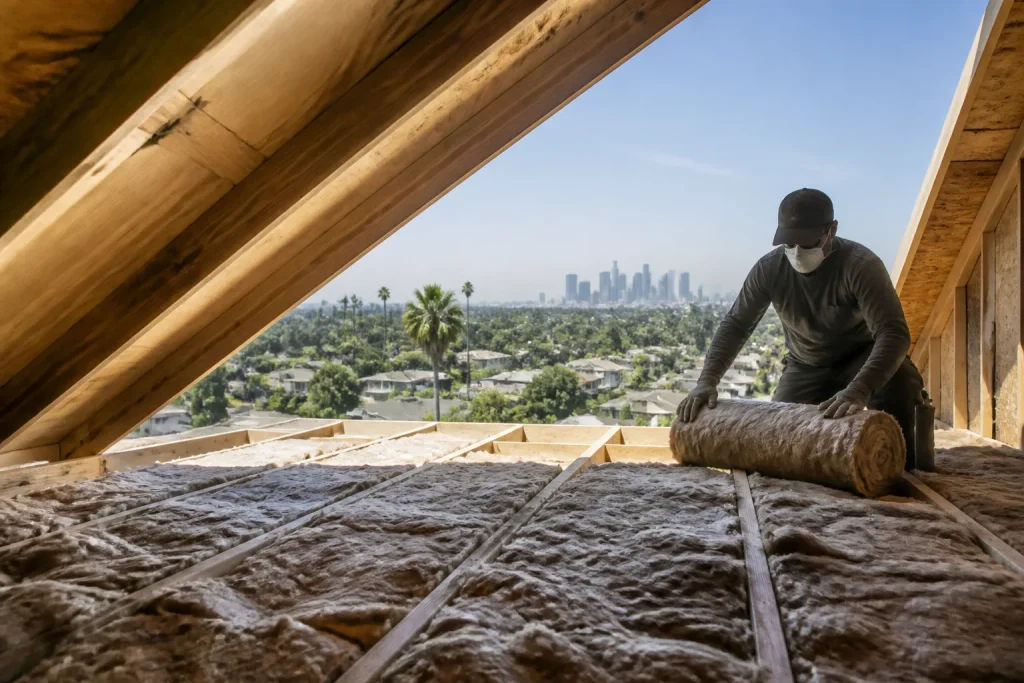
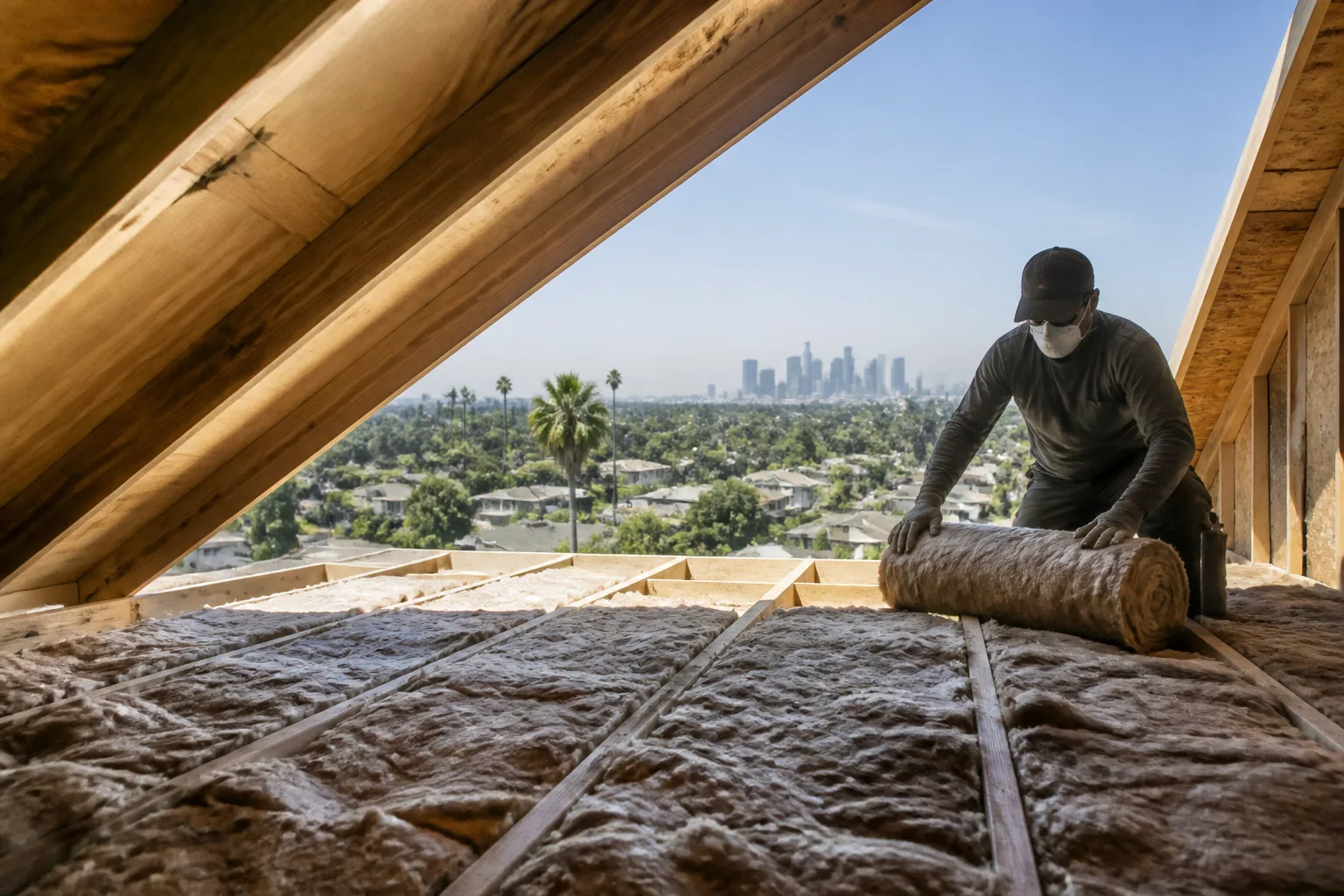
Knauf EcoStar is a blown-in insulation. In plain language, that means loose fiberglass fibers are blown through a hose into the attic cavity, filling gaps and settling around framing, ducts, and electrical boxes. Unlike batt insulation that comes in pre-cut rectangles, blown-in material conforms to whatever shape your attic happens to be, which matters in Los Angeles because so many of our homes were built with non-standard framing, additions, and remodeled rooflines.
EcoStar’s specific chemistry is what makes it relevant for LA homeowners. The binder holding the fibers together is formaldehyde-free. This is a bigger deal here than in cooler climates because attic temperatures in Los Angeles regularly hit 140°F or more during July and August. Older batt products, especially from the 1980s and 1990s, used urea-formaldehyde binders that could off-gas under sustained heat. If your home still has that stuff up there, that’s a replacement conversation, not a repair conversation. If you want to know what you’re currently dealing with, our Attic Insulation in Los Angeles service page explains how we assess existing material before recommending anything.
The recycled-glass content, 70%, matters because Los Angeles homeowners are increasingly asking about embodied carbon and material sourcing. Knauf publishes environmental certifications independently. That’s not marketing fluff, it’s a Declare Label, which lists every ingredient in the product. You should receive a copy of that label after any install. If you don’t, ask for it.
How Knauf EcoStar Compares to JM AttiCat and Owens Corning EcoTouch
All three are reputable blown-in fiberglass products. The difference for Los Angeles comes down to how each performs in a climate where cooling costs dominate heating costs and where attics bake for six months a year.
JM AttiCat is a strong product with a slightly different fiber structure. It tends to settle a bit more quickly in the first few months, which means the installer needs to account for that with additional initial depth. In LA’s dry heat, settlement happens faster. Owens Corning EcoTouch is also formaldehyde-free and widely available. Its fibers are slightly longer, which can help with coverage consistency when installed correctly.
Knauf EcoStar’s advantage lies in its density stability across thermal cycling. LA attics swing from 45°F on a January night to 145°F on an August afternoon. That’s a 100-degree swing, repeated daily through summer. Insulation that holds its loft through those cycles maintains its R-value longer. EcoStar also has a high recycled content that neither AttiCat nor EcoTouch matches at 70%, which matters if environmental certification is part of your decision. In our experience across Los Angeles installs, all three products deliver their rated performance when installed to manufacturer specification. The problem is that “when installed to manufacturer specification” is doing a lot of work in that sentence, and it’s the part most homeowners never verify.
The Depth Problem: What Most Los Angeles Attic Installs Get Wrong
Here’s the number that should worry every Los Angeles homeowner considering attic insulation. Independent thermal imaging surveys, not ours, not Knauf’s, show roughly one in four attic installs across all brands measures two or more inches short of the target depth for the quoted R-value.
Two inches doesn’t sound like much. In insulation terms, it’s significant. R-value is directly tied to installed depth. Blown-in fiberglass delivers roughly R-2.2 to R-2.7 per inch depending on density and product. If your contractor quotes R-38, which is a common Los Angeles recommendation for zone 9 and 10 conditions, the target installed depth for Knauf EcoStar is approximately 11.5 to 12.5 inches. Installing 10 inches instead of 12 drops you from R-38 toward R-30. You paid for R-38. You got R-30. And you’ll pay for that difference in every August electric bill from now until someone fixes it.
Why does this happen so often? Because blowing in two more inches requires more bags and more time. A 1,000-square-foot attic at R-38 needs a specific minimum bag count. Knauf publishes that number on every bag and on their installation specs. A contractor who shows up with 10 bags for a job that needs 14 is telling you something without saying it. The depth indicator cards, those little paper markers stapled to the joists, should be placed throughout the attic, not just near the access hatch. We’ve seen attics where all the indicators are clustered within eight feet of the hatch, where the installer stood, while the far corners got whatever they got.
Garrett Sloane, who runs Aspen Attic Insulation, tells every homeowner the same thing: before we start, we agree on bag count. Before we finish, you can stand on a ladder and read the depth indicators yourself. If it’s short, we don’t leave. That’s the whole job, right there.
How to Verify a Knauf Install Was Done Right
You don’t need to climb into the attic to verify most of this. You need the right questions and the right paper.
First, ask your contractor for the minimum bag count per 1,000 square feet for the R-value they quoted. If they can’t answer on the spot, that’s a red flag. Knauf publishes this. A professional installer who works with the product regularly knows it. Second, ask where the depth indicators will be placed. The answer should be “throughout the entire attic, every 200 to 300 square feet, and you can check them before we leave.” Third, ask what the settled thickness will be versus the installed thickness. Blown-in fiberglass settles over time. Knauf’s specs account for this. The installed depth is higher than the settled depth. If your contractor doesn’t know the difference, they haven’t read the installation guide, which means they haven’t installed it correctly.
After the job, you should have a paper trail. The Declare Label, which lists ingredients. The certificate of installation, which documents date, product, bag count, R-value, and contractor information. And the material safety data sheet. If any of those three is missing, call and ask for it. In Los Angeles, where permits and documentation matter, this paper protects your home’s resale value and your warranty claim. It also protects you if something goes wrong two years later and you need to prove what was installed.
Why Formaldehyde-Free Matters Specifically in LA Attics
Los Angeles is hot. Not Phoenix hot, but hot enough that attics become ovens. Standard shingle roofs, especially darker ones, absorb solar radiation all day. The attic air temperature can exceed 140°F. The surface temperature of the underside of the roof decking can be hotter still.
Formaldehyde is a volatile organic compound that off-gasses more readily as temperature rises. Older fiberglass batt insulation, manufactured before the industry broadly moved away from formaldehyde-based binders, can release measurable amounts under sustained heat. The health concerns are well-documented. The EPA lists formaldehyde as a known human carcinogen at certain exposure levels. For Los Angeles homeowners with existing insulation from the 1980s or 1990s, especially if it’s showing signs of age, that’s not a topic to wave away.
Knauf EcoStar uses a formaldehyde-free binder. So do current JM AttiCat and Owens Corning EcoTouch products. The point isn’t to scare anyone. The point is that if you’re adding insulation, choose a product that doesn’t introduce a known indoor air quality concern into a space that already reaches extreme temperatures. And if your existing insulation predates the early 2000s, have it checked before anyone blows new material on top of it. You don’t want to bury a problem.
Knauf-Specific Installation vs. a Generic Blown-In Job
Most blown-in fiberglass installs look the same from the outside: a truck, a hose, a guy in the attic. The difference is in the prep and the verification. A Knauf-specific installation follows the manufacturer’s published depth and density requirements for the specific R-value quoted. A generic job goes to whatever depth the hose reaches before the installer decides they’re done.
Here are the three questions to ask any contractor who quotes you Knauf EcoStar in Los Angeles:
- What’s the minimum bag count per 1,000 square feet for the R-value on the quote? Write down their answer. Compare it to Knauf’s published spec.
- Where will you place the depth indicator cards, and can I check them before you leave? The correct answer is yes, throughout the attic, and yes.
- What installed depth will you achieve to hit the target settled R-value? They should give you a number in inches that is higher than the settled spec.
If they pause, deflect, or tell you not to worry about it, that’s your answer. A contractor who knows the product welcomes these questions because they’re easy to answer correctly. We tell our Los Angeles customers exactly how many bags are going in and how deep the material will sit, and we hand them the written price before any machine starts. If you’re comparing options, our Blown In Insulation in Los Angeles page explains how we approach blown-in projects from start to finish.
And if you’re considering whether blown-in is even the right product for your specific attic, our Spray Foam Insulation in Los Angeles page covers when foam makes more sense, particularly for attics with ductwork running through the space or homeowners dealing with air sealing as much as thermal resistance.
How Much Does Knauf Attic Insulation Cost in Los Angeles?
Blown-in attic insulation in Los Angeles typically runs $1.75 to $3.25 per square foot, installed, depending on the target R-value, attic accessibility, and whether the existing insulation needs removal first. Here’s a clearer breakdown for a standard 1,200-square-foot attic:
| Scope | Typical Los Angeles Cost Range |
|---|---|
| R-38 Knauf EcoStar, new install | $2,100 to $3,500 |
| R-38 Knauf EcoStar, over existing/upgrade | $1,800 to $3,000 |
| Old insulation removal (separate line item) | $700 to $1,500 |
| Air sealing before insulation | $400 to $900 |
Those are realistic Los Angeles ranges, not national averages. Prices here run higher than the Midwest because labor costs are different, attics are often tighter, and older homes frequently need prep work. A contractor quoting significantly below these numbers is probably quoting fewer bags. Remember: the bag count determines the R-value, and the R-value determines your energy bill. The cheap quote isn’t cheaper if you’re paying for R-38 and getting R-30.
Aspen Attic Insulation provides a written price before any work starts. No post-job surprises. No “we discovered this while we were up there” additions unless you approve them in writing first. That’s the entire point of our upfront pricing model. It’s also why we carry materials from eight different brands, including Knauf, so the product we install is the product that fits your attic and your budget, not just the one we happen to have on the truck. We also work with Aspen Attic Insulation home service standards across every job, which means the technician’s name and photo reach you before they do.
When to Call a Professional
Attic insulation work involves navigating tight spaces, often in extreme heat, while handling fibrous materials. It’s not a casual weekend project. If your attic has vermiculite insulation, which contains asbestos in some LA homes built before the 1990s, do not disturb it. Call a professional for testing and safe handling. If your attic has pest activity, old wiring, or you notice signs of moisture, those are issues to resolve before insulation goes in. And if you have any respiratory sensitivity, stay out of the attic during and immediately after installation.
At Aspen Attic Insulation, every technician is background-checked, identity-verified, and arrives in a clean marked uniform showing a photo ID badge at the door. Their name and photo are sent to you before the visit. If anyone else shows up, the visit is free and we make it right. That’s the Threshold Standard, the operating baseline for every independently owned and operated location under the Threshold Group umbrella since 2002. We built that protocol because the person showing up at your door matters as much as the product going into your attic.
Related Services in Los Angeles
If you’re insulating, you’re probably also thinking about air sealing, ductwork, and ventilation. We handle the insulation side across Los Angeles, from Echo Park bungalows to Tarzana ranch homes. Our Attic Insulation in Los Angeles service covers assessment and installation, our Blown In Insulation in Los Angeles page covers exactly what this guide describes, and our Spray Foam Insulation in Los Angeles page explains when foam outperforms fiberglass. Whichever route you take, the price is in writing before anything starts.
What happens when you call
- 1
A real person answersNo phone trees - you reach a local pro.
- 2
You get an upfront price rangeHonest numbers before anyone is dispatched.
- 3
A background-checked tech heads outLicensed & insured, dispatched right away.
- 4
You approve before work beginsNothing starts until you say go.
The Bottom Line
Knauf EcoStar is a legitimate, high-performing blown-in insulation for Los Angeles attics. Its formaldehyde-free binder matters in our heat. Its recycled-glass content is a genuine sustainability credential. Its R-value performance is proven. But none of that matters if the installer cuts the depth short, and that happens far more often than it should in this city. Verify the bag count. Check the depth indicators. Keep the paper trail. Ask the three questions.
If you’re in Los Angeles and want this handled by a team that writes it all down before we start, Aspen Attic Insulation offers free estimates. Call (864) 428-1615.
Frequently Asked Questions
For Los Angeles, which sits in climate zones 9 and 10, the Department of Energy recommends R-30 to R-60 for attics, with R-38 being the practical sweet spot for most homes because it balances cooling cost reduction against installation cost. Homes with ductwork in the attic or full-sun exposure benefit from the higher end, R-49 to R-60. Call (864) 428-1615 and we’ll assess your specific attic for free.
Check the depth indicator cards placed throughout your attic. For R-38 with Knauf EcoStar, the installed depth should read approximately 11.5 to 12.5 inches. If the indicators are only near the access hatch, or if they read short, call the contractor back. If they won’t return, call Aspen Attic Insulation at (864) 428-1615 and we’ll inspect it.
Yes, all blown-in fiberglass settles slightly in the first few months, which is why manufacturers specify an installed depth higher than the settled R-value target. Knauf accounts for this settlement in their installation specs. If installed to the correct initial depth, the settled R-value should hold at the quoted level for decades. If you’re seeing drafts or uneven temperatures years after an install, call (864) 428-1615 for an assessment.
Installing blown-in insulation requires specialized equipment to fluff and blow the fibers, and getting the density right without it is nearly impossible. You can rent machines, but most homeowners get the depth wrong, and that means paying for R-value you’re not getting. For a professional install with written verification, call (864) 428-1615.
Written by Garrett Sloane, Owner at Aspen Attic Insulation, serving Los Angeles since 2002.
Need Insulation Help?
Call Aspen Attic Insulation - licensed & insured, here with fast after-hours help in Los Angeles.
(864) 428-1615