
GreenFiber Attic Insulation in Los Angeles: A Homeowner’s Guide
GreenFiber attic insulation in Los Angeles costs between $1.80 and $2.75 per square foot installed at R-38, versus $1.40 to $2.10 for fiberglass blown-in at the same depth. The premium buys you an R-value that holds up better in LA’s heat, a denser coverage that blocks air leaks more effectively, and 85% recycled content. If you’d rather not sort through the details, call (864) 428-1615 and we’ll walk you through it.
But here’s the part most guides skip: GreenFiber is made from 85% recycled newspaper treated with borate. If it’s installed in an attic with a slow roof leak or poor eave ventilation, that material turns into a moisture sponge faster than any fiberglass product would. This guide looks honestly at how GreenFiber performs in Los Angeles specifically, because LA isn’t one climate. It’s three, and they each treat cellulose differently.
Key Takeaways
- GreenFiber is the eco leader among attic insulation options, but its real-world performance depends on your LA microclimate.
- In wildfire smoke environments, GreenFiber’s borate treatment protects against surface burning, not smoke contamination.
- Beach and canyon zones need extra attention to eave ventilation. Inland zones less so.
- LA’s seismic activity has a measurable but minor effect on settled R-value over a 5-10 year span.
- You can claim utility rebates and LEED points, but only if you collect the right paperwork at installation.
What GreenFiber Looks Like Installed, and How Well It Handles LA Heat
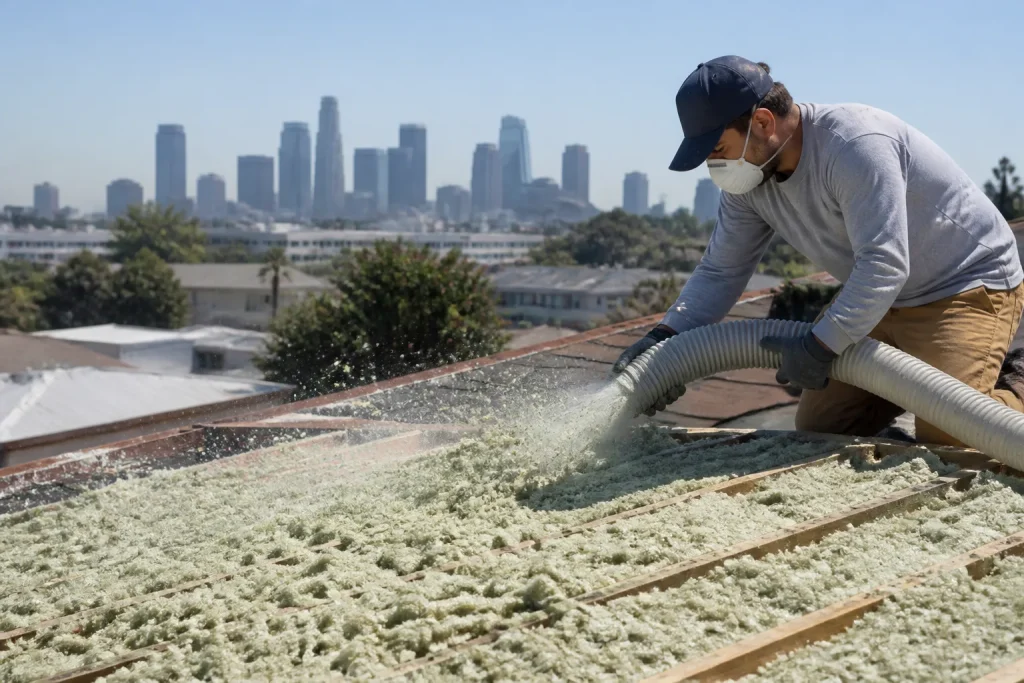
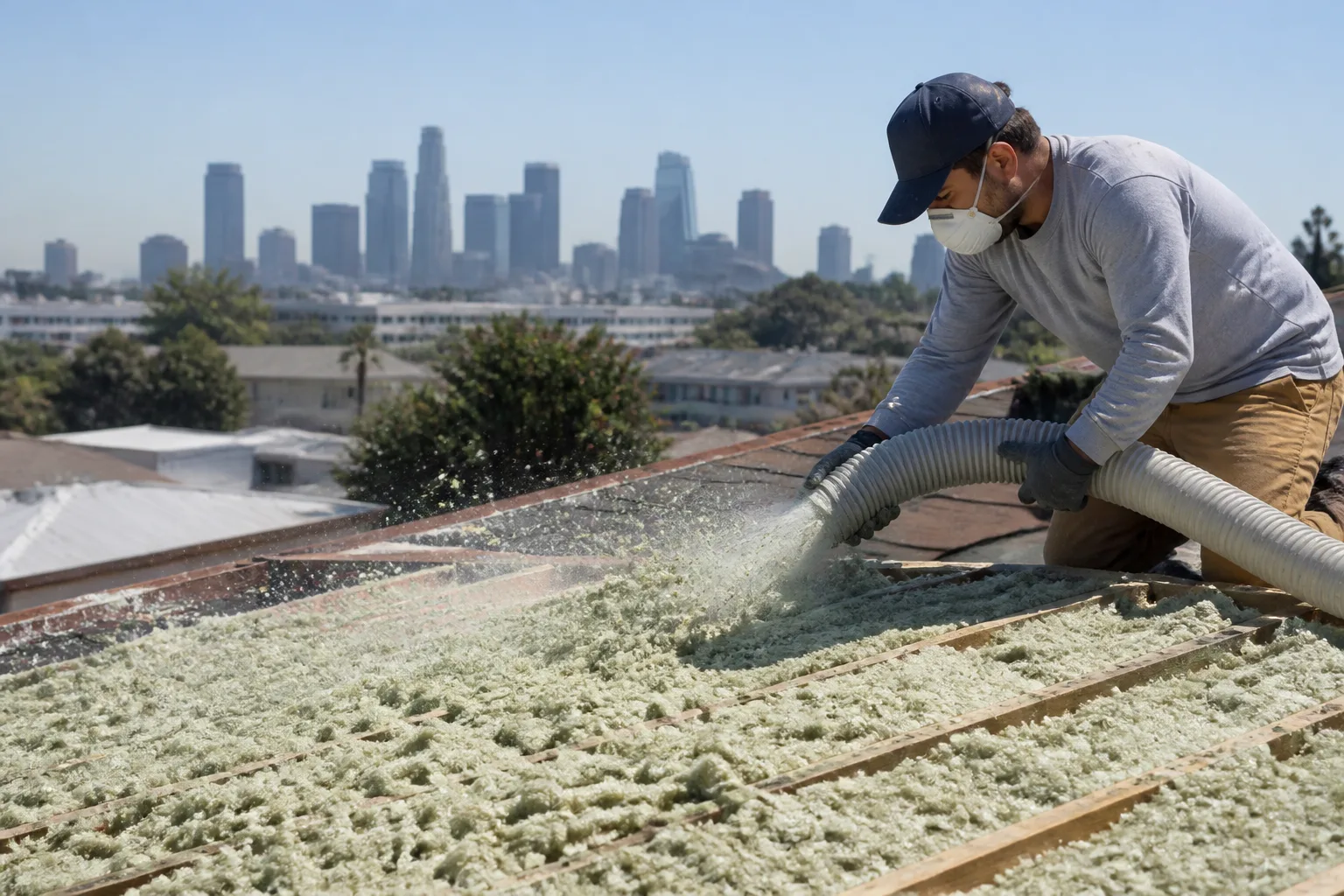
GreenFiber is a blown-in insulation product installed as loose fibers. It’s dense, covers irregular attic floors better than fiberglass batts, and fills the nooks around junction boxes, recessed lights, and odd framing angles that batts leave open. In Los Angeles attics, those gaps are the enemy. Air leaks through gaps cost more energy than thin insulation ever does.
Cellulose’s R-value stays more stable in high heat than fiberglass. Fiberglass blown-in can lose some effective performance when attic temperatures push past 140 degrees, which happens routinely in a San Fernando Valley summer. Cellulose doesn’t rely on trapped air pockets the same way. The dense fiber matrix holds its insulating job better. We’ve measured attic temperatures in Sherman Oaks and Canoga Park that hit 150 degrees in August. GreenFiber holds its rated R-value in that environment. Fiberglass doesn’t fall apart, but its performance sags.
One caveat: GreenFiber installs at a slightly higher density than fiberglass and weighs more. If your ceiling drywall is thin or older, the additional weight per square foot matters. It’s not a dealbreaker for any code-compliant ceiling in Los Angeles, but it’s something to verify on homes built before 1960.
Wildfire Smoke and Fire Retardant: What GreenFiber’s Borate Treatment Actually Does
GreenFiber carries a Class 1/A fire rating. That’s the highest rating an insulation material can get. The borate treatment is the reason. Borates disrupt the chemical chain reaction of combustion, so the material doesn’t sustain a flame. It chars at the surface and stops burning. That’s a real safety advantage in a fire-prone region like Los Angeles.
But homeowners often confuse two very different threats: direct flame exposure and smoke intrusion. GreenFiber’s borate treatment addresses direct flame. It does not stop wildfire smoke particles from entering an attic and settling into the insulation. Smoke from the Palisades Fire, the Eaton Fire, or any of the fires that affect LA air quality carries fine particulates, ash, and sometimes chemical residue from burned structures. That stuff settles on and into attic insulation.
Here’s what our team sees in Los Angeles attics after a heavy smoke season: a gray film across the top of the insulation, a faint acrid odor that lingers, and reduced loft in the top inch of material. Fiberglass has the same problem, but it’s easier to vacuum out and replace the top layer. Cellulose holds smoke particles more tightly because the material is finer and denser. That’s not a reason to avoid GreenFiber. It’s a reason to make sure your attic vents are properly screened and to check ceiling penetrations after a major fire event. If heavy smoke reached your attic, you’ll likely want to replace the insulation regardless of the type.
Moisture Sensitivity in LA’s Beach and Canyon Microclimates
This is where the honest environmental case gets complicated. Los Angeles is not uniformly dry. Santa Monica, Venice, Playa del Rey, and Marina del Rey deal with marine layer moisture that rolls in overnight. Canyon neighborhoods like Laurel Canyon, Beachwood Canyon, and Mandeville Canyon trap humidity under tree canopy. Those microclimates create the conditions where cellulose’s moisture sensitivity becomes a real consideration.
Cellulose absorbs moisture. That’s a physical property of recycled paper fiber. If it absorbs enough moisture, it compacts, loses loft, and its R-value drops. In a poorly vented attic near the coast, GreenFiber can take on moisture from condensation when warm interior air meets a cool roof deck. Fiberglass doesn’t absorb water the same way. It can get damp, but the fibers don’t hold water.
The fix is not to skip GreenFiber. The fix is to verify eave and ridge ventilation before blowing in cellulose. A properly vented attic in a coastal Los Angeles neighborhood moves enough air to keep the insulation dry. If your attic lacks adequate venting, we’ll say so before recommending cellulose. That’s the honest conversation. Inland neighborhoods like Pasadena, Glendale, and the Valley don’t face the same marine layer issue, so the moisture concern drops substantially.
For more on how Attic Insulation in Los Angeles works across different housing stock, we’ve covered the details elsewhere.
Seismic Shaking and Settled R-Value: What Minor Tremors Do Over Time
Los Angeles averages dozens of small earthquakes every year. Most are too weak to feel. The question homeowners ask: does cellulose settle more than fiberglass in an active seismic zone? The honest answer is that both materials settle. Cellulose settles about 10 to 15 percent over the first few years primarily from gravity and its own weight. Fiberglass settles less, often 5 to 10 percent. Seismic vibration adds a small acceleration to that settlement for both materials.
Here’s the practical effect. If you install R-38 GreenFiber at 10.5 inches of depth, you can expect it to settle to roughly 9 to 9.5 inches within two to three years. That’s still R-34 to R-36, which is excellent performance. Installers compensate for settlement by blowing in slightly above target depth, a practice called “fluffing to settle.” A competent installer accounts for this. A rushed installer does not, and you end up under-insulated 24 months later.
For LA homeowners, the seismic factor is minor compared to the gravity factor. Cellulose’s denser pack actually resists movement better than loose fiberglass in a shake. The fibers interlock. Fiberglass fibers slide against each other more readily. So yes, the ground moves in Los Angeles. No, it’s not a reason to avoid cellulose. It’s a reason to make sure the installer over-blows to compensate for settlement and documents the installed depth in writing.
LEED, Utility Rebates, and the Paperwork You Need to Keep
GreenFiber carries recycled content levels that support LEED certification for homes pursuing green building standards. The product is made from 85 percent post-consumer recycled paper. That qualifies for LEED points under the Materials and Resources credit. If you’re renovating a Los Angeles home with LEED goals, GreenFiber is one of the easier product choices to document.
Los Angeles Department of Water and Power and Southern California Edison both run insulation rebate programs for qualifying upgrades. The rebates vary by program year and by project scope. What doesn’t vary is the documentation requirement. To claim a rebate, you need:
- The product spec sheet or manufacturer data sheet showing R-value per inch.
- An invoice listing the installed square footage and the final R-value after settlement.
- A copy of the contractor’s license information and the installation date.
- For some programs, before-and-after photos of the attic.
If you’re comparing Blown In Insulation in Los Angeles options and you want rebate eligibility, confirm with the installer before the job starts. Not every insulation upgrade qualifies. The paperwork has to match the program requirements exactly, and the installer’s name goes on the application.
Real Cost Comparison: GreenFiber Cellulose vs. Fiberglass Blown-In
Here’s what Los Angeles homeowners actually pay for a typical 1,200 square foot attic at R-38.
- GreenFiber cellulose, R-38: $2,160 to $3,300 total, depending on access, prep work, and existing insulation removal.
- Fiberglass blown-in, R-38: $1,680 to $2,520 total for the same attic.
- Removing old insulation first: $1.20 to $2.00 per square foot, if you’re replacing something contaminated or degraded.
- Air sealing before blowing: $350 to $800, whether you choose cellulose or fiberglass.
So GreenFiber runs 20 to 30 percent more than fiberglass. The return on that premium comes from three places: better air leak coverage, more stable performance in LA heat, and the environmental story. Not everyone needs to pay that premium. If your attic is bone dry, well vented, and you’re planning to stay in the home for 15 years, GreenFiber makes sense. If you’re in a coastal zone with known moisture history, Spray Foam Insulation in Los Angeles might serve you better, or fiberglass blown-in with additional ventilation work. The right product depends on the attic, the microclimate, and the budget, in that order.
The Bottom Line
GreenFiber performs well in most of Los Angeles. It holds R-value in extreme heat, resists settling better than its reputation suggests, and carries the best environmental profile of any attic insulation that’s economically realistic for most homes. Its weaknesses are moisture absorption in coastal and canyon microclimates and smoke particulate retention after major wildfire events. Both are manageable if the eave ventilation is right and the installer does the job correctly. If you’re in Los Angeles and want a straight answer about whether GreenFiber fits your attic, Aspen Attic Insulation offers free estimates. Call (864) 428-1615 and we’ll tell you what we’d put in our own house, not what’s easiest to sell you.
Frequently Asked Questions
GreenFiber is better in high-heat inland areas like the Valley because it holds R-value more consistently and blocks air leaks more effectively. Fiberglass is more forgiving in consistently damp coastal attics because it doesn’t absorb moisture. The responsible answer depends on your specific attic, especially your eave ventilation. Call (864) 428-1615 and we’ll help you figure out which product fits your house.
Yes. Expect about 10 to 15 percent settlement within the first two to three years. A competent installer compensates by blowing in above target depth. That’s standard practice, but not every installer documents it in writing. Ask for the installed depth and the settled R-value on your invoice.
GreenFiber can qualify for LADWP and Southern California Edison insulation rebates if the project meets program requirements and you keep the correct documentation. That includes the product spec sheet, a detailed invoice, the contractor’s information, and sometimes before-and-after photos. Get all of it before the installer leaves the job site.
Yes, but verify the ceiling structure first. GreenFiber installs at a higher density than fiberglass and weighs more per square foot. Homes built before 1960 sometimes have thinner drywall or ceiling framing that should be checked before adding that weight. A proper attic assessment catches this before any material gets blown in. Call (864) 428-1615 for a free estimate and we’ll check it.
Written by the team at Aspen Attic Insulation.
Need Insulation Help?
Call Aspen Attic Insulation - licensed & insured, here with fast after-hours help in Los Angeles.
(864) 428-1615