
5 Mistakes to Avoid With Attic Insulation
The five most expensive attic insulation mistakes in Los Angeles aren’t made during installation. They’re made in the 48 hours before the crew arrives, when homeowners are choosing who to hire and what to agree to. Fix the decision process, and the physical work takes care of itself. If you’d rather not wade through any of this alone, call us at (864) 428-1615 and we’ll walk you through it.
Homeowners spend an average of 11 minutes researching an insulation contractor before booking. That’s less time than it takes to read the contract they’re about to sign. We’ve spent two decades watching what happens after those 11 minutes, and the pattern is consistent. The insulation itself rarely fails. The decisions around it do.
Here are the five mistakes we see cost Los Angeles homeowners the most money, in order of how often they happen.
Mistake #1: Accepting a Quote by Phone or Text Without a Written Scope
A real quote tells you exactly what’s going into your attic, in what quantity, by whom. A placeholder tells you a price and an R-value and hopes you don’t ask follow-up questions. Most homeowners can’t tell the difference, and that’s the problem.
“R-38 blown-in insulation, $4,200” is not a quote. It’s a sentence fragment. Which material? How many bags? Installed to what depth across how many square feet? Will the technician air-seal the top plates first, or just blow fiber over the gaps? Who is showing up at your door, and are they background-checked?
Every legitimate insulation contractor in Los Angeles should be able to put the following in writing before you pay a dollar:
- The specific material brand and product line (for example, Johns Manville Climate Pro or Knauf Jet Stream)
- The number of bags or board feet being installed
- The R-value, stated as “installed R-value,” not “approximate”
- The square footage of the attic floor or roofline being treated
- Whether air sealing is included or excluded
- The name of the technician assigned to the job
- The total price, with no open-ended allowances
At Aspen Attic Insulation, we send every homeowner a written price before any work starts. No exceptions, no verbal ballparks. Our techs are identity-verified, photo-badged, and sent to you by name and photo before the visit. If the person who shows up isn’t the person in the photo, the visit is free and we make it right. That’s the Threshold Standard we operate under, and it exists because we watched too many homeowners hand money to someone they’d never seen before.
If a contractor won’t put the full scope in writing, that’s not a scheduling conflict. That’s a tell.
Mistake #2: Skipping the Air Sealing Step to Save Money
This is the mistake that makes our techs sigh. Homeowners in Los Angeles regularly pay for premium insulation while leaving the attic floor riddled with unsealed penetrations, then wonder why their upstairs bedroom still hits 84 degrees in August.
Here’s the physics in plain language. Insulation slows heat transfer through the attic floor. Air sealing stops conditioned air from leaking out of your living space into the attic through gaps at top plates, plumbing penetrations, recessed lights, and electrical boxes. If you skip air sealing, you’re putting an R-38 blanket over a colander. The insulation makes the colander slightly less leaky, but the leaks are still doing most of the damage.
For Los Angeles homes built before 1990, air sealing often delivers more energy savings than adding R-value above an unsealed attic floor. We’ve tested this repeatedly. A pre-1990 LA house with R-19 batts and proper air sealing will outperform the same house with R-38 blown over gaping top-plate gaps. Every time.
The cost difference is typically $800 to $1,200 for air sealing on a standard 1,200-square-foot attic in Los Angeles. That’s not a line item to cut. That’s the line item doing the heavy lifting.
When we install blown-in insulation, air sealing is part of the scope. We use a foam sealant at every penetration, then a foam block or dam at the soffit vents, then the insulation goes in. The order matters. Insulation first, sealing second is just insulation stuffed over holes, and you’ve paid full price for half a job.
Mistake #3: Insulating Over Damaged or Pest-Contaminated Material
This one is hard to accept, because it means spending money before the visible upgrade happens. Homeowners look through the attic hatch, see batts that appear intact, and assume the existing insulation can stay put. New blown-in goes right over the top. Done, right?
Wrong, and in Los Angeles it’s wrong more often than most people think.
Rodents, especially roof rats, treat LA attics like rent-controlled apartments. They nest in fiberglass batts, defecate throughout the material, and compress it into mats that have lost most of their thermal performance. The part of the attic you can see from the hatch might look okay. The deeper sections, the corners, the areas behind ductwork, those are where the damage concentrates.
Blowing new insulation over rodent-saturated material does three bad things:
- It traps the contamination under a fresh layer, so the smell lingers and the air quality issues persist
- It leaves compressed, dead batts underneath doing nothing, which means your “new” attic insulation is only partially functional
- It hides the evidence, so the next homeowner, or the next you, discovers the problem years later at triple the removal cost
We pulled contaminated batts out of an attic in Los Angeles one week where the homeowner had been assured by another contractor that everything “looked fine from the hatch.” It took four hours to bag and remove what was under there. The smell in the upstairs hallway disappeared within a day, and the homeowner’s summer cooling bill dropped by a noticeable margin the following month.
If your attic has had rodents at any point, get an inspection from someone who will actually walk the full attic, not just poke a head through the hatch. Removal costs more than leaving it in place. But you’re paying either way. You can pay now, once, or pay later in energy bills and a bigger remediation job.
Mistake #4: Blocking the Soffit Vents With Blown-In Insulation
This is a physical mistake, but it stems from a decision mistake: hiring a crew that doesn’t know or doesn’t care about attic ventilation, and not asking about it before they start.
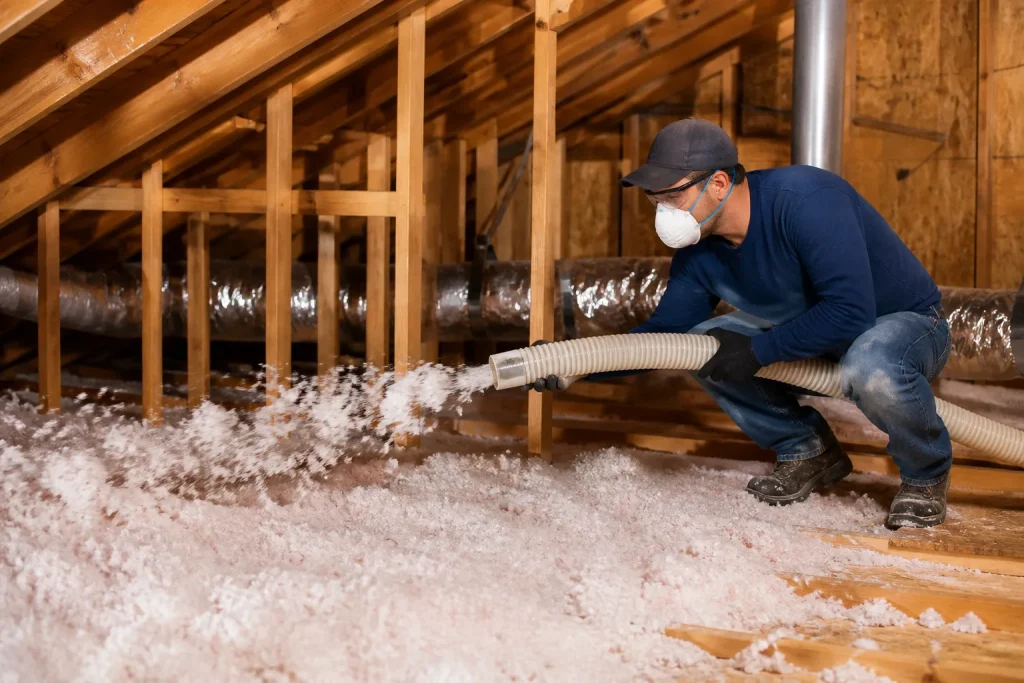
Blown-in insulation that gets pushed into the soffit vents blocks the intake airflow that an attic needs to breathe. In Los Angeles, where summer attic temperatures routinely push past 140 degrees, a blocked soffit vent turns your attic into a heat dome. The trapped heat bakes your ductwork, forces your AC to work harder, and can shorten the life of your roof decking.
The moisture problem is just as bad. Without intake airflow, winter condensation has nowhere to go. Moisture settles into the new insulation, compressing it and degrading its R-value within two to three years. We’ve seen blown-in cellulose that was installed at R-38 but performed closer to R-19 by year three because the soffits were plugged and the material had gone matted and damp.
The fix is simple and should be standard practice: install baffles, also called vent chutes or rafter vents, at every soffit vent before blowing any material. A baffle is a rigid foam or plastic channel that staples to the roof deck and keeps a clear air path from the soffit to the attic. They cost a few dollars each, and they take minutes to install. Skipping them is not a money-saving shortcut. It’s a code violation and a moisture trap.
When we install blown-in insulation in Los Angeles, baffles go in at every single soffit vent. No exceptions, no “we’ll see how it goes.” If a contractor gives you a blank look when you ask about baffles, that’s your answer.
Mistake #5: Treating a Verbal Guarantee as Binding
Every contractor says their work is guaranteed. Most of them mean it in the moment. The problem is what happens 8 months later when the insulation settles, or a section of the attic wasn’t covered, or the air sealing failed and the bedroom is hot again.
In California, a verbal guarantee exists in a legal gray zone that favors the contractor. It comes down to your word against theirs, and “the work speaks for itself” is not a defense you want to rely on in small claims court. A guarantee only means something when it’s written, specific, and tied to a defined remedy.
Here’s what a written guarantee should actually cover:
- The duration of the guarantee (days, months, or years, stated as a number)
- What’s covered: labor only, materials only, or both
- The specific remedy: repair, replacement, or refund
- The timeframe for response after you report a problem
- Whether the second visit is free
- Any exclusions, written in plain language
Our 365-Day Done Right Promise is in writing on every job. It covers labor and materials for a full year. If a repair fails, we come back and make it right, free of charge, within the terms of the guarantee. It’s not a verbal assurance. It’s a document, and you get a copy before we start.
Garrett Sloane, our owner, put this in place because he watched too many homeowners get burned by promises that evaporated the moment the check cleared. The guarantee has to exist on paper, in your hand, before the work begins. Otherwise it’s just a sentence someone said while holding a clipboard.
When you’re comparing insulation contractors in Los Angeles, ask this question: “Can I see your written guarantee before I sign?” If the answer is anything other than “yes, here it is,” keep looking.
When to Call a Pro
All five of these mistakes share one root cause: the decision made before the work starts. You can avoid most of them by demanding written specifics and refusing to accept vague assurances. But some things genuinely require a trained eye. Attic inspections, air sealing at top plates and penetrations, pest contamination assessment, and ventilation diagnostics are not DIY tasks. If you’re not sure what’s under the existing insulation, don’t guess. A wrong guess is the most expensive kind.
If you’re in Los Angeles and you’d rather have someone who’s done this a few thousand times look at your attic, we’re easy to reach. Related services we handle locally include attic insulation in Los Angeles and blown-in insulation in Los Angeles. If you’re considering foam for a specific roofline or difficult space, we also install spray foam insulation in Los Angeles. You can learn more about who we are at the Aspen Attic Insulation home page.
The Bottom Line
Attic insulation mistakes in Los Angeles are almost always decision mistakes, not installation mistakes. A written scope prevents price surprises and material substitutions. Air sealing is not optional, it’s the step that makes insulation work. Existing damaged material has to come out before new material goes in. Soffit vents need baffles, always. And a guarantee is only as good as the paper it’s printed on.
If you’re in Los Angeles and need help, Aspen Attic Insulation offers free estimates, written prices before any work starts, and a 365-Day Done Right Promise in writing on every job. Call (864) 428-1615 and a live person will answer, any hour, any day.
Frequently Asked Questions
The biggest mistake we see in Los Angeles is hiring a contractor based on a phone quote without a written scope of work. A real quote specifies the material brand, bag count, installed R-value, square footage, air sealing details, and the technician assigned. Without those specifics, the price you’re quoted is a placeholder, not a commitment.
Yes, and it’s especially important in Los Angeles homes built before 1990. Air sealing stops conditioned air from leaking through gaps at top plates, plumbing penetrations, and electrical boxes. Adding insulation without sealing those gaps is like putting a warm blanket over an open window. Call (864) 428-1615 for an exact quote on air sealing and insulation together – estimates are free.
You can, but only if the old material is clean, dry, and uncompressed. In Los Angeles, where roof rats are common, existing batts are often compressed and contaminated deeper in the attic where you can’t see them from the hatch. New insulation over contaminated material traps the problem. We recommend a full attic inspection before deciding whether removal is necessary.
Ask to see it in writing before you sign anything. A real guarantee states the duration in days, specifies whether labor, materials, or both are covered, describes the remedy, and confirms the second visit is free if a repair fails. Verbal guarantees are not enforceable in any meaningful way in California. Our guarantee runs 365 days, covers labor and materials, and comes to you on paper before work begins.
Written by Garrett Sloane, Owner at Aspen Attic Insulation, serving Los Angeles since 2002.
Need Insulation Help?
Call Aspen Attic Insulation - licensed & insured, here with fast after-hours help in Los Angeles.
(864) 428-1615