
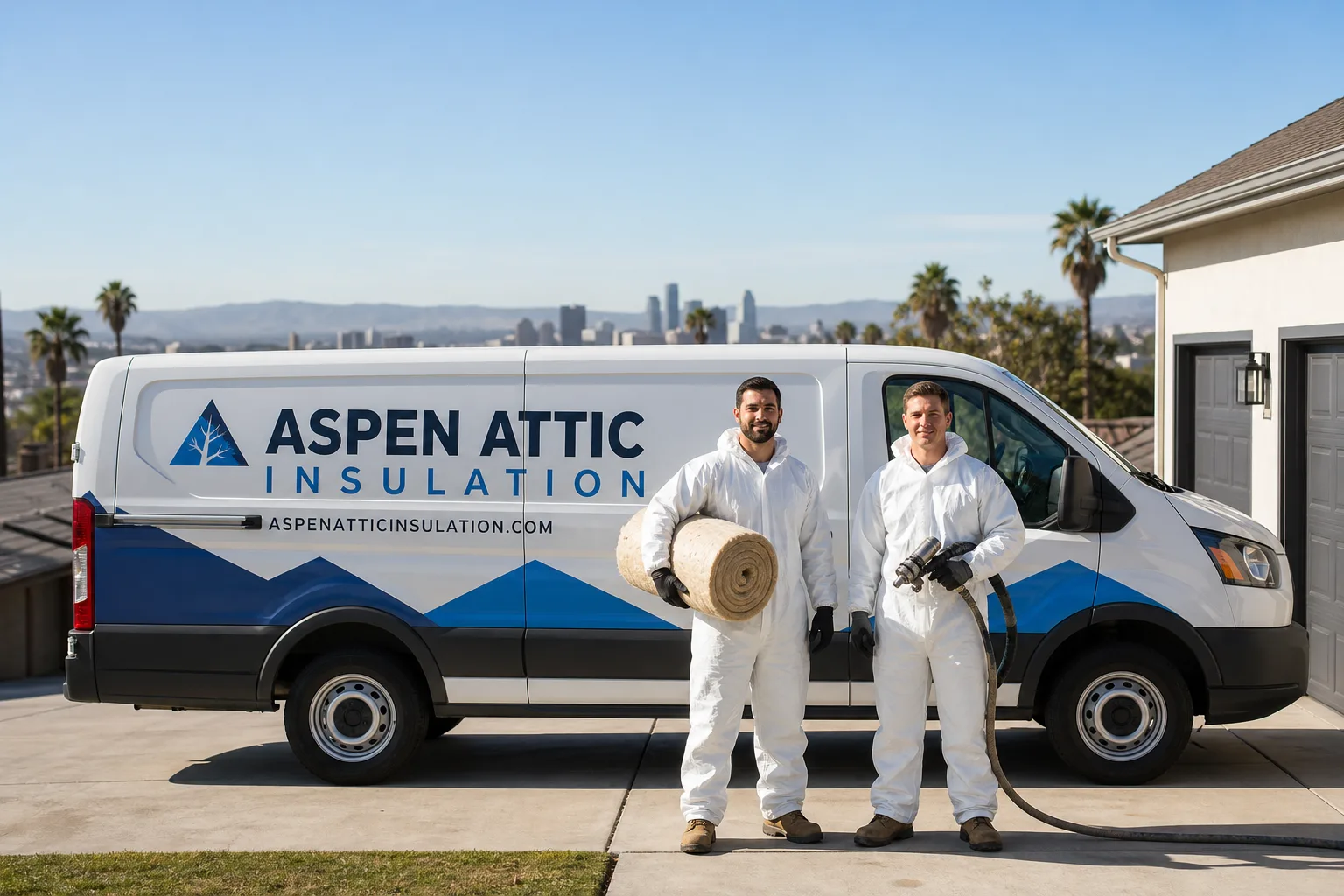
Fast, Reliable Attic Insulation Across West Covina
Most attic insulation jobs in West Covina run $1,200 – $3,800 depending on attic size and condition, and our crews typically book within 48 hours. We’re familiar with the tract homes in Shadow Oaks, the two-story builds in South Hills, and the older stock near Azusa Avenue. Dispatch is coordinated from our Los Angeles office, but the crew that arrives at your West Covina door lives and works in the San Gabriel Valley. Call (864) 428-1615 for a free written estimate.
Why Aspen Attic Insulation Is West Covina’s Preferred Attic Insulation Company
We’ve been insulating attics in the eastern San Gabriel Valley long enough to know what West Covina homes actually need. The Threshold Standard means every technician is background-checked, identity-verified, and sent to you by name and photo before the visit. If someone else shows up, the visit is free and we make it right.
Our 365-Day Done Right Promise covers every job in writing. If the repair fails, we come back free.
Calls from West Covina are answered by a live person, 24/7. No voicemail loops.
Attic Ventilation in West Covina
Attic Ventilation in West Covina is non-negotiable because your attic hits 140-150°F on summer afternoons with zero marine layer relief. Without proper airflow, that heat radiates through drywall and cooks your second floor. We install baffles, soffit vents, and ridge vents to create passive air exchange that flushes superheated air before it transfers downward.
When Ventilation Fails
Blocked soffits are the most common problem we find in West Covina’s 1950s-70s tract homes. Previous owners stuffed insulation against the eaves, killing airflow. We pull it back, install proper baffles, and re-insulate without choking the vent path.
Ventilation Plus Insulation
Ventilation alone won’t stop heat gain. The pairing matters. We size airflow to match your insulation depth so the system works together, not against itself.
Radiant Barrier in West Covina
Radiant Barrier in West Covina blocks the infrared heat that blasts through roof decking after 10 a.m. most summer days. In this inland heat island, radiant barrier can reduce attic heat gain by 20-35% compared to insulation alone. We install perforated foil barriers across rafters or roof decking, depending on your attic geometry.
Best Applications
Radiant barrier pays back fastest on homes with dark shingle roofs and minimal existing shade. Many South Hills two-stories with west-facing roof planes see the biggest comfort jump.
What It Doesn’t Replace
Radiant barrier reflects heat but doesn’t insulate against conduction. We use it as a layer in the stack, not a substitute for proper R-value in the attic floor.
Trusted Brands We Service in West Covina
We stock Johns Manville, Knauf, Rockwool, and CertainTeed products at our Los Angeles-area warehouse, so West Covina jobs don’t wait on material delivery. Each brand serves a specific need: Johns Manville for high-R batts in standard attics, Knauf for blown-in fiberglass with low dust, Rockwool for fire-resistant applications near chimney runs, CertainTeed for dense-pack scenarios in vaulted cavities. We match the material to your attic’s condition, not our convenience.
Common Attic Insulation Problems We See in West Covina Homes
- Compacted R-6 original fiberglass in Shadow Oaks and South Hills tract homes. That 1950s-70s shredded fiberglass has settled to the density of felt. It barely slows heat transfer, and HVAC contractors have shoved it aside over decades of equipment changes.
- Insulation debris in yards after Santa Ana winds each fall. When degraded attic insulation starts showing up on lawns along Amar Road and Cameron Avenue, the attic layer has broken down enough to let 140-150°F heat radiate straight into living spaces.
- Uneven blown insulation in 1980s-90s vaulted ceilings. Blown product settles in hard-to-reach cavities over South Hills two-stories, leaving radiant heat paths that make upstairs bedrooms unusable by mid-July.
- Bare drywall over living rooms from electrical and HVAC runs. We regularly find 4-6 foot gaps where contractors never replaced insulation after running new lines. The ceiling is literally unprotected.
Pricing for Attic Insulation in West Covina, CA
A typical attic insulation top-off in West Covina runs $1,200 – $2,100 for 1,000-1,500 square feet. Full replacement in a compacted 1950s tract attic runs $2,400 – $3,800. Radiant barrier addition adds $800 – $1,600. Attic ventilation prep with baffles runs $400 – $900.
What moves the number: attic square footage, current insulation depth, accessibility (vaulted ceilings cost more), whether we need to remove degraded material first, and whether top plates and penetrations need sealing. We give you a written price before any work starts. Every time. No exceptions. Call (864) 428-1615 for your free estimate.
We Also Serve Cities Near West Covina
Our crews work throughout the eastern San Gabriel Valley, including Attic Insulation in West Covina and surrounding cities: La Puente, Covina, Baldwin Park, and Azusa. Same technician protocols, same written pricing, same 365-day guarantee.
Serving West Covina, CA - Our Local Coverage Area
We’re based in the West Covina area and know this community well. Use the map below to see our service coverage - if you’re nearby, we can almost certainly help.
FAQs About Attic Insulation in West Covina
It hasn’t disappeared; it’s degraded to the point where Santa Ana winds pull loose fibers through soffit vents and gaps. In Shadow Oaks, we regularly find original 1960s shredded fiberglass that’s been disturbed by decades of HVAC and electrical work, leaving it light enough to blow into yards. Call (864) 428-1615 and we’ll assess whether a top-off or full replacement is needed.
West Covina attics routinely hit 140-150°F in summer, while coastal LA rarely exceeds 110-120°F due to marine layer cooling. That 30°F difference is why insulation upgrades here deliver sharper cooling-cost payback than at the beach. We size R-value and radiant barrier to this specific heat load.
Yes, but the approach differs. Vaulted ceilings have limited cavity depth, so we use dense-pack blown fiberglass or Rockwool to maximize R-value per inch, plus targeted radiant barrier on accessible roof planes. We inspect with a borescope first to confirm cavity condition.
We typically use Knauf or Johns Manville blown fiberglass for West Covina top-offs, matched to existing material type. Knauf runs lower dust, which matters in occupied homes. Johns Manville offers higher R-per-inch when cavity depth is limited. We stock both locally.
Ventilation matters as much here because 140-150°F attic air needs an escape path. Without it, heat saturates insulation and transfers downward regardless of R-value. We always check soffit and ridge venting before adding material. A choked attic makes even good insulation underperform.
Written by Garrett Sloane, Owner at Aspen Attic Insulation, serving West Covina and the San Gabriel Valley since 2002.