
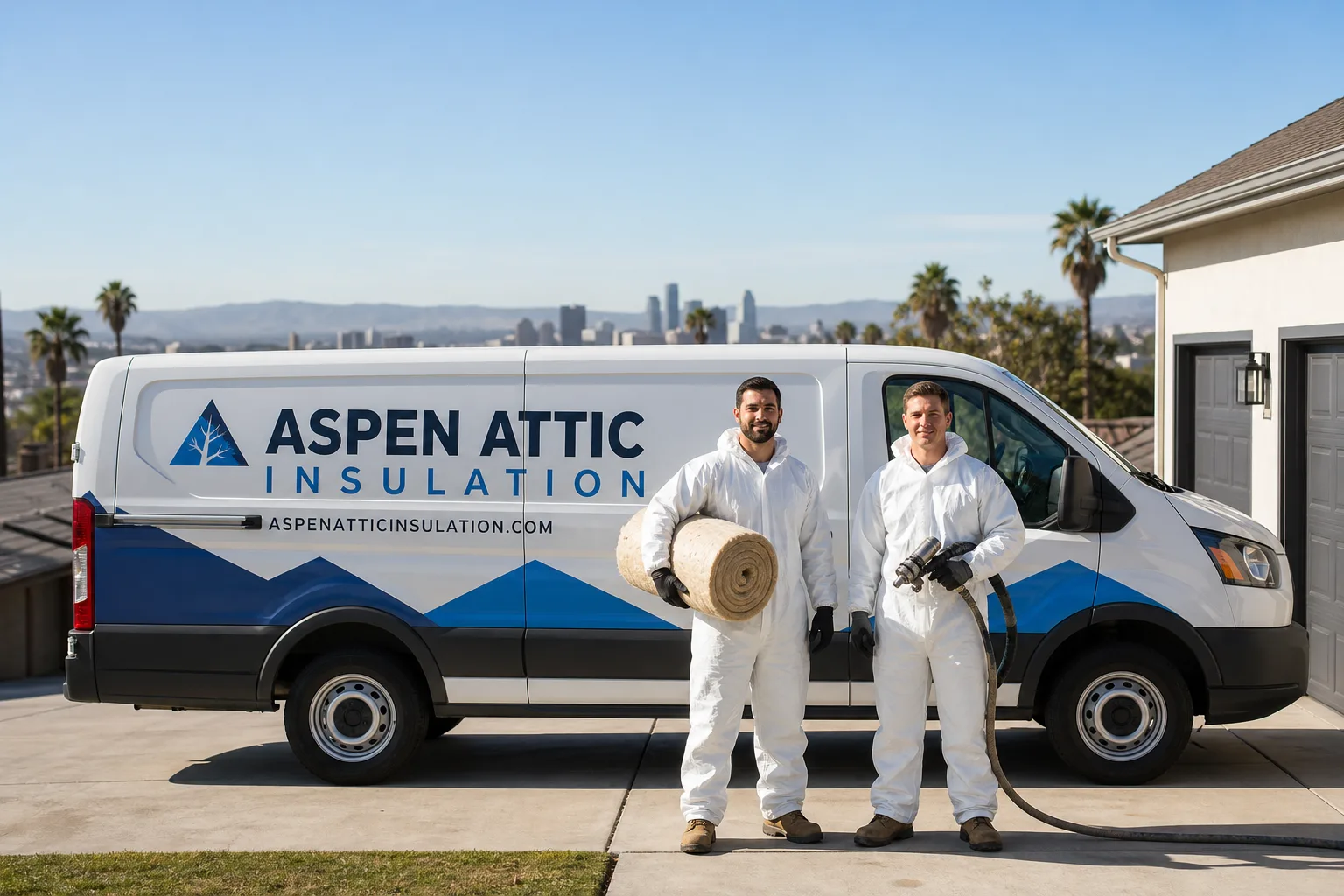
Fast, Reliable Attic Insulation Across Bell
Attic insulation in Bell, CA typically costs $1,800 – $4,500 for a full replacement, with blown-in top-ups running $900 – $1,800 and ventilation or radiant barrier add-ons adding $400 – $1,200. Most Bell homes need same-day assessments because the city’s post-WWII stucco tracts trap heat aggressively, and crews from our Los Angeles office can usually be on-site within hours.
We know Bell’s streets well. From the compact stucco homes along Gage Avenue to the 1950s tracts near Bell High School and the wood-frame houses off Florence Avenue, our Attic Insulation team has worked in attics across this city. Garrett Sloane built Aspen Attic Insulation on the Threshold Standard: you get the technician’s name, photo, and written price before anyone knocks. In Bell, where many homeowners are older adults or families with young children, that transparency matters. Call (864) 428-1615 for a free estimate.
Why Aspen Attic Insulation Is Bell’s Preferred Attic Insulation Company
We’ve earned our reputation in Bell by solving problems specific to this city. Our technicians understand that a stucco-over-wood-frame house built in 1953 behaves differently than a modern tract home in South Gate. That local knowledge shows up in how we air-seal top plates, how we drill stucco for wall insulation without spider-cracking the finish, and why we won’t blow new material over collapsed old batts without addressing what’s underneath.
Our response time to Bell is typically same-day or next-morning. Dispatch coordinates from our Los Angeles office, but crews live and work in the area. When you call (864) 428-1615, a live person answers, 24/7. No voicemail loops. No “we’ll call you back between 2 and 6.”
Every technician is background-checked, identity-verified, and arrives in a clean marked uniform with a photo ID badge. We send you their name and photo before the visit. If anyone else shows up, the visit is free and we make it right. That’s The Threshold Standard, and it’s how we’ve operated since 2002.
Our 365-Day Done Right Promise covers every job in writing. If a repair fails, we come back free. No arguments, no paperwork battles.
Attic Ventilation in Bell
Attic Ventilation in Bell is not optional. It’s essential. The same stucco skin that gives Bell its characteristic look traps heat in the attic cavity like a sealed box. Without proper airflow, summer attic temperatures regularly hit 130 – 150°F, cooking whatever insulation sits below and forcing your AC to fight an uphill battle.
Most Bell homes we assess have inadequate ventilation: a few rusted static vents, maybe a gable vent blocked by decades of dust, and no ridge vent at all. The original builders didn’t design for modern insulation loads or the extended heat waves that now stretch from May through October.
What Proper Ventilation Looks Like
We install ridge vents along the peak, paired with soffit vents and baffles to create continuous airflow from eave to ridge. This pulls hot air out before it saturates your insulation. In Bell’s 1940s – 1960s tracts, we often have to cut new soffit venting where none existed, or replace painted-shut originals. The work runs $600 – $1,400 depending on linear footage and whether we need to add baffles to keep insulation from blocking airflow.
When Ventilation Becomes Urgent
If your attic smells musty in fall, if you see dark streaks on the underside of your roof deck, or if your second-story rooms stay hot past 10 p.m., your ventilation has failed. In Bell’s climate, that trapped moisture degrades cellulose and fiberglass from the top down, even when the bottom layers look fine.
Radiant Barrier in Bell
Radiant Barrier in Bell pays for itself faster than in almost any nearby city. The combination of intense solar exposure, dark shingle roofs, and stucco walls that re-radiate heat into the attic makes radiant heat transfer the dominant cooling load in most Bell homes. A properly installed radiant barrier can reduce attic heat gain by 20 – 35%.
We install perforated radiant barrier foil across the rafters or directly over existing insulation, depending on your attic’s configuration. In Bell’s low-pitch 1950s roofs, we often use a hybrid approach: foil on the rafters plus a reflective coating on the roof deck when accessible. Costs range from $800 – $1,800 for a typical 1,000 – 1,400 square foot Bell attic.
Why Stucco Homes Need It Most
Stucco has high thermal mass. It absorbs heat all day and releases it inward for hours after sunset. Without a radiant barrier, that delayed heat transfer keeps your attic hot well into the evening, long after the sun’s down. We’ve measured 110°F attic temperatures at 9 p.m. in Bell homes without barrier protection.
Installation That Lasts
We use tear-resistant, double-sided aluminum products rated for attic conditions. Cheap hardware-store rolls tear during installation and degrade within a few years. Our materials come from Owens Corning, Johns Manville, and CertainTeed, selected for your specific roof geometry and ventilation pattern.
Trusted Brands We Service in Bell
We stock materials from eight industry-leading brands, including Knauf, Rockwool, and CertainTeed, with local inventory positioned for Bell-area jobs. That means no two-week waits for specialized batts or dense-pack cellulose. When we assess your attic, we specify the exact product by brand and model, not “whatever’s on the truck.” For Bell’s older homes with irregular joist spacing and shallow cavities, we often reach for Rockwool’s flexible batts or Knauf’s blown-in fiberglass, which conform to uneven surfaces better than rigid alternatives. Fast turnaround matters here because once a homeowner feels that 140°F attic heat radiating through the ceiling, they don’t want to wait.
Common Attic Insulation Problems We See in Bell Homes
- Collapsed original fiberglass batts. The 1940s – 1960s tracts near Gage Avenue and Florence Avenue were built with R-11 or R-19 fiberglass batts that have settled to 1 – 2 inches thick. They’re visible, so homeowners think they’re insulated. They’re not. Effective R-value is often below R-5.
- Heat-cooked insulation near the roof deck. Bell’s unventilated stucco attics hit temperatures that degrade cellulose binders and make fiberglass brittle. We pull out material that crumbles to dust, evidence that the attic has been operating like a slow oven for years.
- Stucco cracks from careless wall-insulation drilling. Not our work, but we repair the aftermath. Contractors who don’t understand Bell’s stucco-over-wood-frame construction drill too aggressively, spider-cracking exterior walls. We use controlled penetration techniques and patch matched to your finish.
- Air leaks bypassing new insulation. Old Bell homes have gap-filled top plates, recessed light housings, and chimney chases that let conditioned air escape into the attic. Without sealing these first, new insulation performs at a fraction of its rating. We find them with blower door testing and infrared imaging.
Pricing for Attic Insulation in Bell, CA
Here’s what attic insulation costs in Bell’s market right now:
- Attic insulation top-up (blown-in over existing): $900 – $1,800
- Full attic insulation replacement, including removal: $2,800 – $4,500
- Attic batt insulation (new construction or fully cleared attic): $1,600 – $3,200
- Attic ventilation upgrade (ridge + soffit vents, baffles): $600 – $1,400
- Radiant barrier installation: $800 – $1,800
- Attic baffles and ventilation prep only: $400 – $900
Your final price depends on attic square footage, accessibility, whether we need to remove degraded material first, and whether your stucco home needs paired ventilation and radiant barrier work. We don’t guess. We inspect, measure, and give you a written price before any work starts. Estimates are free. Call (864) 428-1615 to schedule.
We Also Serve Cities Near Bell
Our crews work throughout the southeast Los Angeles corridor. We regularly insulate attics in Bell as well as Maywood, Huntington Park, Bell Gardens, and South Gate. Each city has distinct housing stock and climate patterns, and we adjust our approach accordingly. Whether you’re in Bell proper or a neighboring community, the same Threshold Standard applies: written price, verified technician, 365-day guarantee.
Serving Bell, CA - Our Local Coverage Area
We’re based in the Bell area and know this community well. Use the map below to see our service coverage - if you’re nearby, we can almost certainly help.
FAQs About Attic Insulation in Bell
Without ventilation, your stucco shell traps heat and moisture in the attic cavity, which degrades new insulation from above within 2 – 3 years. In Bell’s climate, we’ve seen R-38 blown-in cellulose perform like R-15 because 140°F attic temperatures cooked the material. Proper ridge and soffit ventilation protects your investment. Call (864) 428-1615 for an assessment of your current airflow.
Yes, but it requires controlled drilling technique and proper patching matched to your stucco texture. We drill small access holes at stud bays, blow dense-pack cellulose, and patch with color-matched stucco mix. In Bell’s 1940s – 1960s tracts, we’ve refined this process to avoid the spider cracking that inexperienced contractors cause. Call (864) 428-1615 to discuss whether your walls are good candidates.
We recommend R-38 to R-49 for Bell attics, with R-38 as the practical minimum for most existing homes. California Title 24 now calls for R-49 in new construction, but many Bell attics can’t accommodate that depth without raising the floor or modifying hatch access. We assess your joist depth and structural load to find the right target for your specific home.
Usually yes. That original fiberglass has settled, likely contains dust and debris from decades of roof work, and may be harboring moisture damage. We remove it, inspect the deck for leaks or mold, air-seal all penetrations, then install new material. Blowing over old collapsed batts is cheaper upfront but wastes money long-term. We give you both options in writing.
In Bell’s climate, with intense solar exposure and stucco walls that re-radiate heat, a radiant barrier is one of the highest-ROI upgrades you can make. We’ve measured 20 – 35% reductions in attic heat gain, which translates to shorter AC run times and more even temperatures in second-story rooms. It’s not overkill here. It’s appropriate engineering.
Written by Garrett Sloane, Owner at Aspen Attic Insulation, serving Bell and surrounding communities since 2002.