
Blown In Insulation: Repair or Replace? How Los Angeles Homeowners Decide
Most blown-in insulation doesn’t need replacing. It needs topping off. The decision comes down to two numbers: your current settled R-value and the cost-per-R-point of adding material versus removing it. If your attic tests below R-30 and the existing insulation is dry, clean, and free of rodent activity, adding fresh blown-in fiberglass or cellulose on top is almost always the smarter financial move. If you’d rather not crawl around your attic with a tape measure, call (864) 428-1615 and we’ll do the math for you.
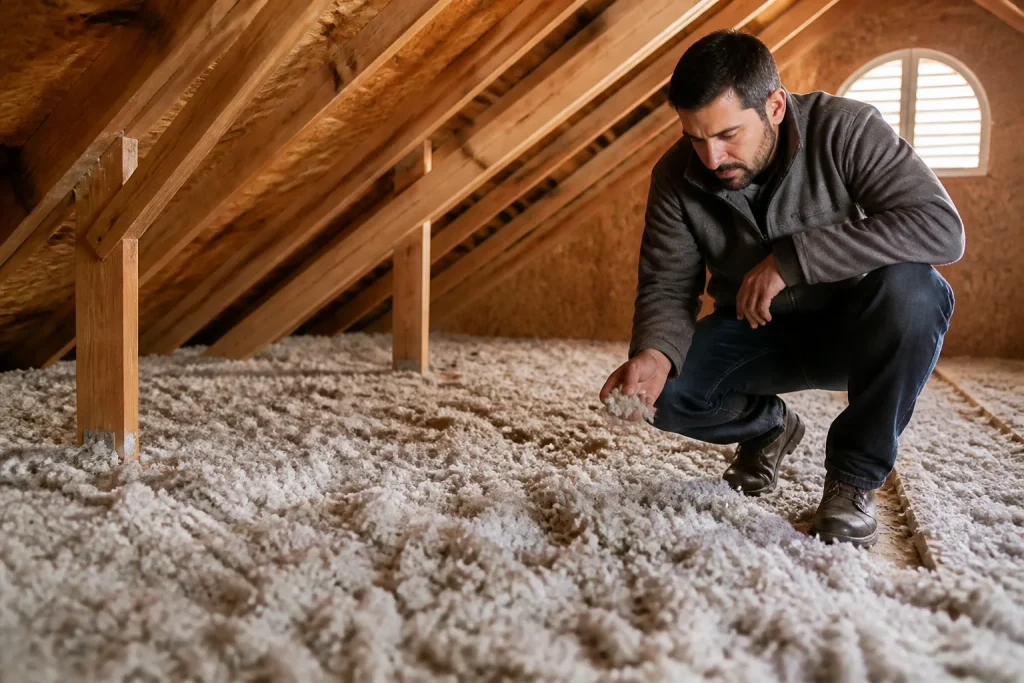
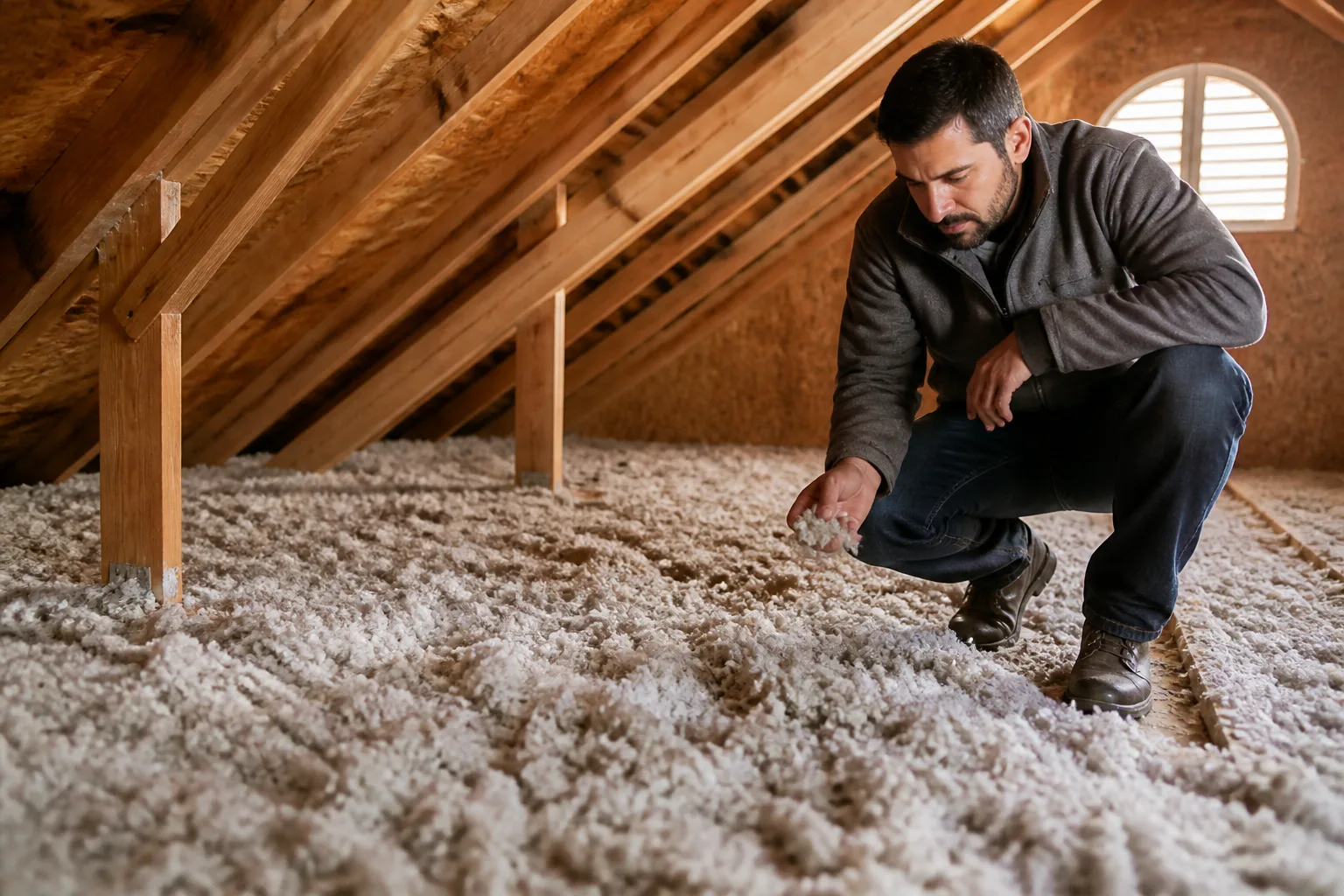
Blown-in insulation settles 15 to 20 percent in its first few years. An attic installed to R-38 in 2018 is probably sitting at R-32 today, and most Los Angeles homeowners have no idea. That’s not a failure of the product. That’s physics. Loose fibers compress under their own weight, lose trapped air pockets, and deliver less thermal resistance per inch. The question isn’t whether settlement happened. The question is what it means for your energy bills and whether a partial repair gets you back to where you need to be.
How to Measure What You Actually Have (Not What the Sticker Says)
Every attic hatch in Los Angeles has a sticker on it, and almost none of them reflect reality. Builders or previous owners write the target R-value, not the current settled value. If you want a true repair-or-replace answer, you need three measurements: average depth across the attic floor, the material type, and the condition of the existing layer.
Here’s how to do it in about 20 minutes:
- Measure depth in at least six spots. Attics settle unevenly. Corners and edges compact more than the center. Use a yardstick, not your fingers. Push it down to the drywall, not just to where the fibers look fluffy.
- Average those numbers. If your six readings are 9, 8, 7, 8, 6, and 8 inches, you’re averaging 7.7 inches. That’s your real working depth.
- Identify the material. Fiberglass is white or pink and has a slight shimmer. Cellulose is gray and looks like shredded newspaper. Rockwool is darker, denser, and chunkier. Each has a different R-per-inch value.
- Convert depth to R-value. Loose-fill fiberglass delivers about R-2.5 per inch settled. Cellulose runs R-3.4 to R-3.7. Rockwool lands around R-3.0 to R-3.3. Use the manufacturer’s settled density chart, not the blown-in density number on the bag.
So that 7.7-inch average in fiberglass is about R-19. In cellulose, it’s roughly R-27. Same depth, very different performance. Los Angeles homes built before 1980 often have as little as R-11 to R-19 in the attic, which is why we see summer cooling bills spike in neighborhoods like Van Nuys, Reseda, and Glassell Park where original insulation was never upgraded.
When you’re doing this inspection yourself, wear a dust mask and long sleeves. Fiberglass particles irritate skin and lungs. Walk only on joists. And if you see anything more than surface dust, hold off and call someone before disturbing it.
Three Conditions Where Topping Off Is the Right Call
Adding new blown-in material on top of existing insulation is called a “cap” or “top-off,” and in most Los Angeles attics it solves the problem completely. The old layer doesn’t need to be perfect. It needs to be dry, clean, and structurally sound. Here are the three conditions that make a top-off the clear choice:
1. Your existing insulation is dry and free of rodent activity. If the fibers crumble when you pinch them, they’re still doing their job. The air pockets remain. Fresh material blown on top fills the gaps and restores lost R-value without disturbing the old layer.
2. Your attic currently tests below R-30. Title 24, California’s energy code, requires R-38 for new construction and most significant remodels in the Los Angeles climate zone. Topping off from R-19 to R-38 costs roughly one-third to one-half what a full removal and replacement costs, because labor is simpler and you’re not paying for disposal. We quote this work as cost per R-point so homeowners see the math, not a lump sum with no context.
3. You’re adding insulation as part of a smaller project, not a gut remodel. If you’re reroofing soon, wait. But if you just want lower bills this summer, capping the existing layer delivers immediate results. The new material settles, but a proper installation over-compensates so you’re at or above target even after compaction.
In our experience around Los Angeles, roughly 70 percent of attics we look at are top-off candidates. The insulation is old but functional. The homeowner just never knew it settled.
Three Conditions Where Full Removal Is Non-Negotiable
There are attics where adding material just buries a problem. These are the ones where replacement is the only responsible recommendation.
1. Rodent contamination. Rats and mice tunnel through blown-in insulation, leaving urine, droppings, and nesting material throughout the entire layer. You can’t spot-treat rodent-contaminated insulation. The tunnels run everywhere. Blowing fresh material on top seals the contamination in and leaves you with an attic that still smells and still harbors airborne particles that drift down through light fixtures and duct seams. A full removal, sanitation, and air sealing, then fresh insulation, is the only correct fix. We pulled a nest out of a Silver Lake attic last month that had chewed through the paper backing of the entire underside. The homeowner thought the smell was from a dead tree outside.
2. Moisture damage and mold. Water from a roof leak, condensation, or a bathroom vent discharging into the attic instead of outside can saturate insulation. Wet fiberglass loses almost all insulating value. Wet cellulose clumps and rots. Mold grows, spreads, and becomes a respiratory hazard. If you see darkened patches, a musty smell, or insulation that feels damp to the touch, don’t cap over it. Remove it, find and fix the water source, then install new material.
3. Your current R-value is below R-11 or the material is physically breaking down. Some 1950s and 1960s Los Angeles attics have ancient cellulose that’s turned to dust or fiberglass that’s flattened to almost nothing. There’s no air pocket structure left. Topping off a dead layer doesn’t bring it back.
Here’s the simplest way to think about it: moisture and rodents mean replace. Everything else is usually a repair.
What a Written Repair-or-Replace Recommendation Should Include
Contractors in Los Angeles are happy to tell you your insulation “looks fine” from the attic hatch. That’s not an inspection. That’s a glance. Insulation condition varies from corner to corner, and the areas that matter most, around plumbing stacks, chimneys, and recessed lights, are also the areas most likely to hide problems.
A legitimate repair-or-replace recommendation should be written, and it should include at least these five things:
- Six or more depth measurements from across the attic floor, with a calculated average.
- The material type and its settled R-value per inch, using the manufacturer’s chart, not a guess.
- Documented evidence of moisture, mold, or pest activity if replacement is recommended. If a contractor wants you to pay for removal, they should show you why with photos taken in your own attic.
- A cost breakdown showing the price per R-point for topping off versus removing and replacing, so you can compare apples to apples.
- The projected post-work R-value in writing, with a guarantee covering what happens if the target isn’t met.
A verbal “it looks fine” is not enough. You’re spending real money on this. You deserve numbers you can verify. When we prepare a written price at Aspen Attic Insulation home visits around Los Angeles, the homeowner sees the current R-value, the target R-value, the material we’re installing, and the total price, all in writing, before any work is scheduled. That’s the only honest way to do it.
Related services in Los Angeles: if you’re exploring insulation options, you can compare blown in insulation in Los Angeles, attic insulation in Los Angeles, or spray foam insulation in Los Angeles to see which fits your attic conditions and budget.
Blown In Insulation Repair Cost in Los Angeles: What the Numbers Look Like
Homeowners ask us the cost question before anything else, so let’s put real numbers down. Blown-in insulation is priced by board foot of material and by installation hour, but for a typical 1,500 to 2,000 square foot Los Angeles home, the table below is a realistic starting point.
| Scope of Work | Typical Range in Los Angeles |
|---|---|
| Top-off from R-19 to R-38 (1,500 sq ft attic) | $900 – $1,600 |
| Top-off from R-11 to R-38 (1,500 sq ft attic) | $1,200 – $2,200 |
| Full removal, air sealing, and R-38 installation | $3,500 – $6,500 |
| Rodent remediation + insulation replacement | $4,500 – $8,000+ depending on sanitation scope |
| Attic air sealing only (no insulation change) | $600 – $1,400 |
These are honest ranges based on what we’ve quoted across Los Angeles County over the last few years. Your attic size, access difficulty, and existing conditions move the needle. The key number to calculate is cost per R-point. If topping off from R-19 to R-38 costs $1,300 and adds 19 R-points, you’re paying about $68 per R-point. If removing and replacing the same attic costs $5,000 to reach the same R-38, you’re paying $263 per R-point for the same thermal improvement. The difference is usually waste removal, labor intensity, and sanitization, not better insulation performance.
Materials we install include CertainTeed blown-in fiberglass, which holds its loft well and settles predictably, and Rockwool stone wool, which adds fire resistance and sound dampening on top of the R-value. For attics with complex shapes or tight access, Demilec’s open-cell spray options are sometimes a better envelope fit. The right material depends on your attic, not on what’s already on hand.
When to Call a Pro
You can measure your own attic insulation with a yardstick and a calculator. You shouldn’t try to remove contaminated insulation yourself, and you shouldn’t guess at whether that dark patch is mold or just old dust. If you see rodent droppings, damp insulation, or burned-looking spots around recessed lighting, call a professional before disturbing anything. We’ve seen Los Angeles homeowners pull down a section of ceiling because they stepped off a joist, and we’ve seen others spend a full weekend hauling fiberglass bags out of an attic only to discover the roof leak that caused the problem was still active. Insulation work is straightforward when it’s straightforward. When it’s not, it costs more to fix a DIY attempt than to have it done right the first time.
The Bottom Line
Get the numbers before you spend anything. Measure your settled depth. Calculate your actual R-value. Check for moisture and rodent activity. If the insulation is dry and clean and you’re below R-30, topping off is almost always cheaper and just as effective as replacing. If you’ve got contamination or water damage, replacement isn’t optional, it’s the only fix that protects your air quality. If you’re in Los Angeles and want the math done for you, Aspen Attic Insulation offers free estimates. We send the technician’s name and photo before the visit, the price comes in writing before any work starts, and the job is covered by our Done Right Promise. Call (864) 428-1615.
Frequently Asked Questions
Check for three things: moisture, rodent activity, and severe settling below R-11. If you find wet insulation, droppings or nesting material, or insulation that’s flattened to a dust-like consistency, replacement is required. If the material is dry and clean but just settled below R-30, you can usually top it off with fresh blown-in insulation instead of removing it. Call (864) 428-1615 for a free attic inspection in Los Angeles if you’re unsure.
Topping off is significantly cheaper. In Los Angeles, adding insulation to bring an attic from R-19 to R-38 typically costs $900 to $1,600, while a full removal and replacement often runs $3,500 to $6,500. The difference is labor and disposal costs, not material. If your existing insulation is clean and dry, topping off delivers the same R-value for roughly a third of the price.
Yes, as long as the old insulation is dry, free of rodents, and hasn’t been compromised by mold. New blown-in fiberglass or cellulose can be installed directly on top, filling gaps and restoring lost R-value without removal. This is called capping or topping off, and it’s the most common repair we do across Los Angeles.
Most repair jobs, which means topping off settled insulation to R-38, run between $900 and $2,200 for a typical 1,500 to 2,000 square foot home in Los Angeles. Full removal and replacement with air sealing starts around $3,500. Rodent remediation adds significant cost depending on the extent of contamination. Call (864) 428-1615 for an exact written quote because attic size and condition vary widely.
Written by the team at Aspen Attic Insulation.
Need Insulation Help?
Call Aspen Attic Insulation - licensed & insured, here with fast after-hours help in Los Angeles.
(864) 428-1615