
Rockwool Attic Insulation in Los Angeles: A Homeowner’s Guide
Rockwool attic insulation costs between $2.20 and $4.10 per square foot installed in Los Angeles, which runs roughly 30 to 50 percent higher than blown-in fiberglass. What you get for that premium is the only common attic insulation that actively resists fire. In a city where whole neighborhoods sit inside wildfire hazard zones, that distinction is worth understanding before you sign any quote.
If you’d rather talk through your attic specifics than wade through numbers, call (864) 428-1615 and a real person will pick up. But if you’re researching first, here’s what actually matters about Rockwool in an LA attic, minus the marketing gloss.
Why Fire Performance Should Come Before R-Value in Los Angeles
During the 2018 Woolsey Fire, post-event structural analysis found something most insulation salespeople never mention: attics insulated with mineral wool showed measurably slower fire progression in a small number of surviving structures. That finding matters more than any marketing department’s claims, because it came from real homes in real fire conditions.
Rockwool is made from basalt rock and recycled slag that gets spun into fibers at temperatures above 2,900°F. The finished product won’t melt until the temperature passes 2,000°F. Compare that to fiberglass, which softens around 1,000°F and loses structural integrity, leaving framing exposed. During a wildfire ember event, embers land on roofs and get sucked into attic vents. Fiberglass insulation melts away from the ember, and the ember then sits directly on wood sheathing. Rockwool does not ignite, does not fuel the fire, and acts as a physical barrier between the ember and the structure.
In Los Angeles, this is not a theoretical conversation. Large portions of the Santa Monica Mountains, the Verdugo Hills, Bel Air, Brentwood’s canyons, Encino’s hillsides, Porter Ranch, Chatsworth, and most of the San Fernando Valley’s rim communities sit inside or directly adjacent to the Very High Fire Hazard Severity Zone. If you own a home in any of those areas, your insulation conversation should start with fire resistance, not just R-value per inch.
How Much Does Rockwool Attic Insulation Cost in Los Angeles?
Here are the real numbers, based on what we’re quoting across LA County right now:
- Rockwool COMFORTBATT R-30 (attic floor application): $2.80 to $3.60 per square foot installed
- Rockwool COMFORTBATT R-38 (attic floor, higher-efficiency option): $3.40 to $4.10 per square foot installed
- Blown-in fiberglass R-38 (for comparison): $1.60 to $2.30 per square foot installed
- Blown-in cellulose R-38 (for comparison): $1.80 to $2.50 per square foot installed
For a standard 1,200-square-foot attic in a San Fernando Valley ranch house, that puts full Rockwool batt installation at roughly $3,400 to $4,900, versus $1,900 to $2,800 for blown-in fiberglass. The gap is real, and we’ll be honest about when it’s worth paying.
A note on the product line: Rockwool Safe’n’Sound gets mentioned a lot in insulation discussions, but it’s designed for interior wall and floor cavity sound control. It is not the right product for an attic. The product you want for attic thermal insulation is Rockwool COMFORTBATT, which comes in R-values calibrated for attic floor and ceiling joist cavities. Any quote that lists Safe’n’Sound for an attic application should be questioned.
What Rockwool Installation Actually Involves That Other Materials Don’t
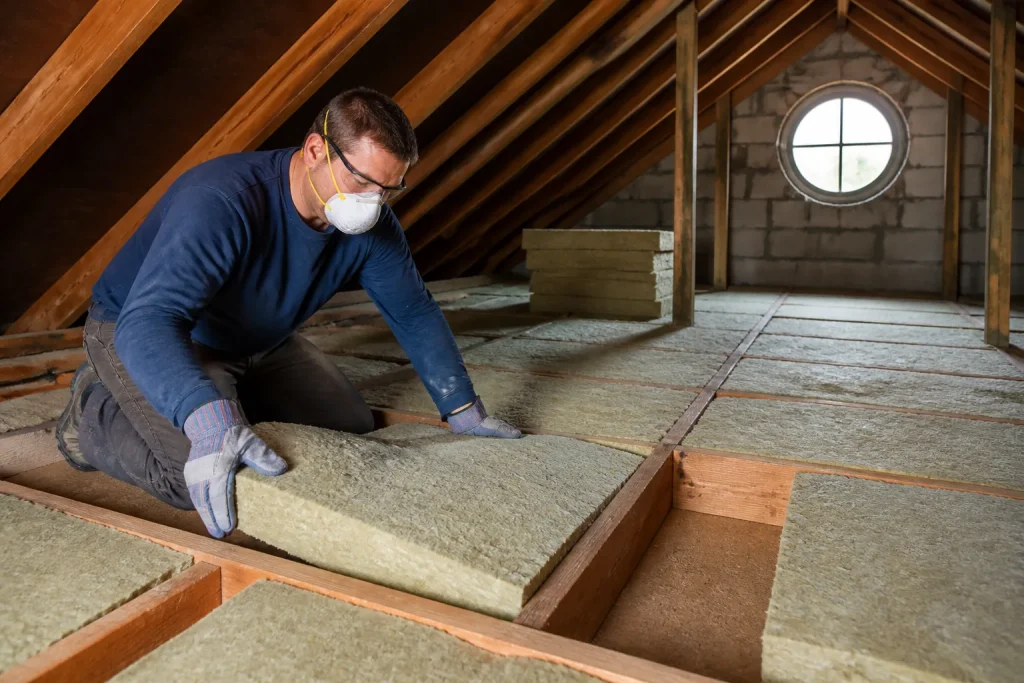
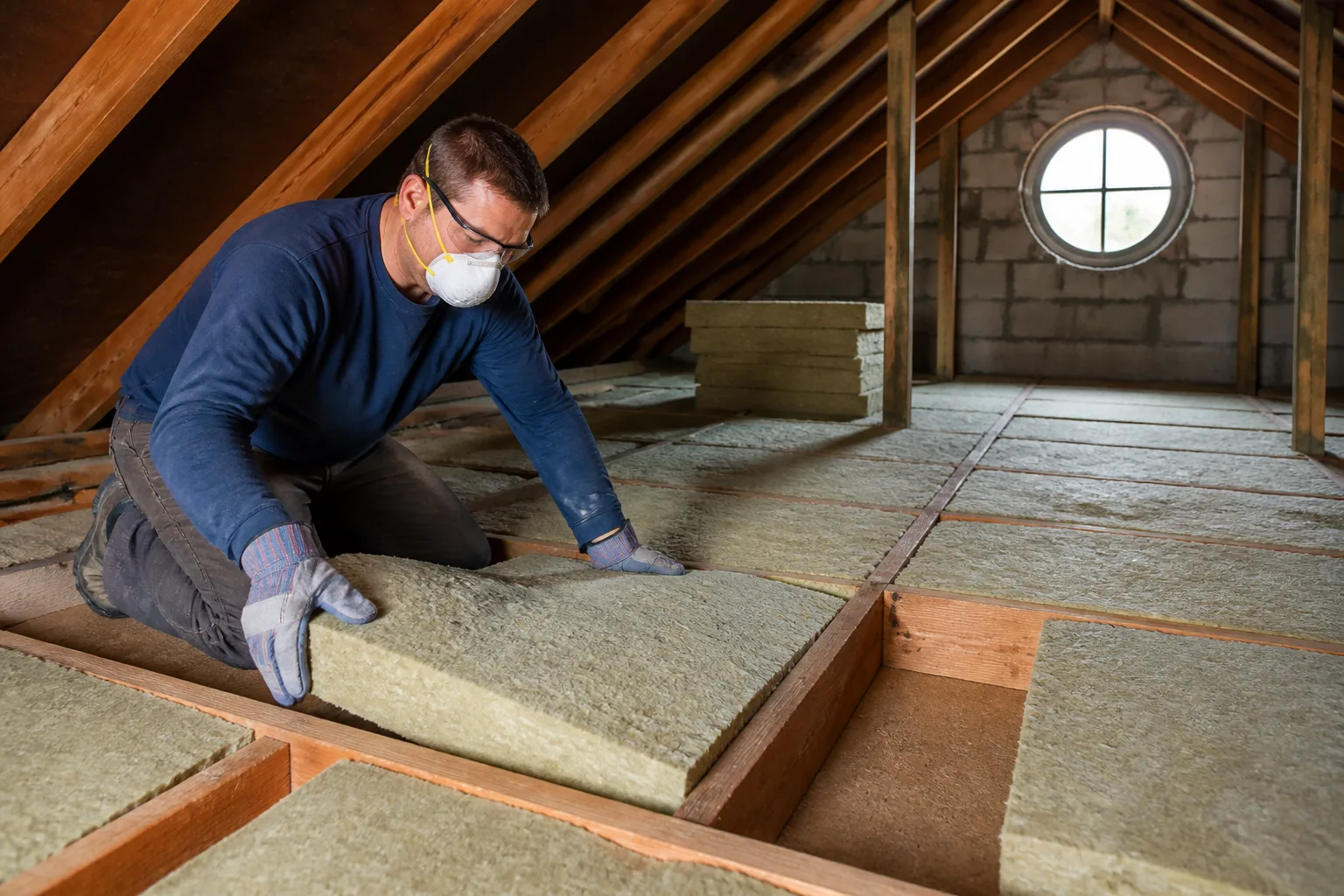
Rockwool batts are heavier and denser than fiberglass. That density is what gives the product its fire resistance and sound-dampening properties, but it also changes the installation process significantly.
First, Rockwool cannot be installed with a standard blowing machine. Blown-in insulation moves through a hose and fills cavities with loose fibers. Rockwool comes in rigid batts that must be cut to fit each joist bay by hand. That means more labor, fewer shortcuts, and a technician who actually understands how to cut a product that fights back against a utility knife. Compressed Rockwool loses R-value, so sloppy cuts create thermal gaps. A rushed crew will leave gaps. A careful crew will take the time to friction-fit each batt so it stays in place for decades.
Second, because the batts are dense, they’re unforgiving around obstacles. Recessed light housings, vent baffles, plumbing stacks, and HVAC ductwork all require custom cuts. In older Los Angeles homes, which often have non-standard joist spacing, that means more waste and more installation time than a newer build.
Third, Rockwool is heavier per square foot than fiberglass, which means your attic framing carries more weight. For most properly built homes, this is a non-issue. But if you have older rafters, sagging drywall, or existing structural concerns, you need those addressed before adding a heavier insulation product.
If you’d rather skip the research and get a written price for your specific attic, call (864) 428-1615. We tell you the number before the work starts, not after.
When Rockwool Is the Right Call for an LA Home
Rockwool earns its premium in several specific situations that happen all over Los Angeles:
- You live in or near a Very High Fire Hazard Severity Zone. If your ZIP code falls in the hills above Studio City, the canyons off Mulholland, the Porter Ranch ridges, or the foothills around La Cañada, the fire-resistance argument for Rockwool is hard to beat. Ember intrusion through attic vents is the single most common way homes ignite during wildfires, and Rockwool is the only insulation that directly resists that ignition path.
- You have older wood-frame construction. Most pre-1980 Los Angeles homes have balloon framing or gable roofs with direct attic-to-wall air paths. Rockwool’s density reduces air movement through those paths better than loose-fill products.
- You live under a flight path or near a freeway. Rockwool’s density provides meaningful sound reduction. If you’re in Westchester under the LAX approach, or in Sherman Oaks near the 405, the acoustic benefit is noticeable the day the insulation goes in.
- You want insulation that never settles. Blown-in fiberglass and cellulose can settle over years, losing R-value from the top of the cavity. Rockwool batts maintain their thickness permanently because the density keeps them rigid.
We’ve pulled old insulation out of attics in North Hollywood and Eagle Rock where blown-in fiberglass had settled from R-38 to effectively R-20 in under a decade. That settlement problem simply doesn’t happen with batts. When a homeowner asks us why they should pay more for Rockwool, our answer starts with fire resistance and ends with the fact that the R-value they pay for is the R-value they’ll still have in fifteen years.
When Rockwool Is Not the Right Call
We install Rockwool, and we also install a lot of blown-in fiberglass and cellulose. Here’s the honest counterargument, because a good contractor tells you when the premium product isn’t worth the money.
If your attic has tight or irregular geometry. Older Los Angeles homes, especially bungalows and cottages in Highland Park, El Sereno, and parts of Long Beach, can have joist bays that are narrow, inconsistent, or partially obstructed. Blown-in insulation fills every gap naturally. Rockwool requires physical cutting and fitting, and in a cramped attic, the labor cost climbs quickly.
If your budget is fixed and you’re far from fire hazard zones. If you live in the flatlands of Mid-City, Culver City, or Torrance, your wildfire ember risk is meaningfully lower than a hillside home. A well-installed blown-in fiberglass job from Owens Corning or Knauf material gives you excellent thermal performance at a significantly lower installed cost. That’s the right call for many homes.
If you’re planning an HVAC upgrade soon. Rockwool makes attic space harder to work in. If you’re about to replace ductwork or install a new air handler, you may want to do the mechanical work first, then insulate. And if your attic geometry already makes that work tight, blown-in insulation may be more forgiving when technicians need to move around.
The goal is matching the product to the home, not winning an argument about which material is “best.” We stock Rockwool alongside brands like Attic Insulation in Los Angeles uses from Owens Corning, Johns Manville, and GreenFiber precisely because the answer changes from house to house.
How to Evaluate Any Rockwool Quote in Los Angeles
When you get quotes for Rockwool installation, here’s what separates a real professional from a crew that’s figuring it out as they go:
- Does the quote specify COMFORTBATT, not just “Rockwool”? Safe’n’Sound is the wrong product for an attic, as covered above. If the bid doesn’t name the exact product line and R-value, ask for a revised quote.
- Does the contractor discuss vent baffles? Any attic insulation job in Los Angeles needs to maintain airflow from soffit vents to roof vents. Rockwool’s density makes baffle installation more critical than with blown-in product. A contractor who skips this detail will leave you with moisture problems.
- Does the quote cover air sealing? Insulation without air sealing is like wearing a thick coat that’s unbuttoned. Gaps around recessed lights, plumbing penetrations, and top plates let conditioned air leak straight through the insulation layer. A real quote addresses this up front.
- Does the crew have experience with dense batts specifically? Blown-in fiberglass crews are not automatically good at Rockwool installation. Ask how many Rockwool attics the company has installed in the last year. If the answer is vague, keep looking.
At Aspen Attic Insulation home, we send the technician’s name and photo to you before the visit. That’s the standard we built our reputation on, and it applies whether we’re installing Rockwool, spray foam, or blown-in. You know who’s walking through your door before they knock.
The Bottom Line
Rockwool is the only common attic insulation that directly resists wildfire ember ignition, and for homeowners in or near Los Angeles fire hazard zones, that property outweighs the R-value conversation most contractors default to. It costs more, it takes longer to install, and it requires a technician who knows what they’re doing. For many homes, especially those in the hills and canyons, the premium is justified. For flatland homes far from hazard zones with straightforward attic geometry, blown-in fiberglass from a quality manufacturer remains a smart, cost-effective choice.
The right answer depends on your ZIP code, your attic, and your budget, not on which product a contractor happens to stock. If you’re in Los Angeles and want a written price for Rockwool, blown-in fiberglass, or Spray Foam Insulation in Los Angeles, Aspen Attic Insulation offers free estimates. Call (864) 428-1615 and a live person will answer, day or night.
Frequently Asked Questions
If you live in or near a Very High Fire Hazard Severity Zone, yes. Rockwool’s fire resistance and non-combustible composition provide real protection during an ember event that fiberglass and cellulose cannot match. If you’re in a flatland area with no wildfire exposure, the premium may not be justified for a purely thermal insulation job. Call (864) 428-1615 for an honest assessment of your specific ZIP code and attic.
For most Los Angeles attics, R-30 to R-38 is the right target. The Department of Energy recommends R-30 to R-60 for Zone 3 climates, which covers most of LA County. Rockwool COMFORTBATT is available in R-30 and R-38 thicknesses designed for standard 2×10 and 2×12 attic floor joists. A free attic inspection will confirm what your framing can accommodate.
No. Los Angeles has a Mediterranean climate with dry, hot summers and mild winters, which means vapor barriers are rarely needed in attic floor applications. Rockwool is moisture-resistant and vapor-permeable, so it allows proper drying if any moisture does accumulate. This is one of the reasons it performs well in older LA construction that lacks modern vapor management.
Rockwool batts will last the life of the home. Unlike blown-in fiberglass and cellulose, which settle and lose R-value over time, Rockwool maintains its thickness and thermal performance indefinitely because the dense batts don’t compress. The only reason to replace it would be water damage, animal intrusion, or a remodel that disturbs the attic.
Written by Garrett Sloane, Owner at Aspen Attic Insulation, serving Los Angeles since 2002.
Need Insulation Help?
Call Aspen Attic Insulation - licensed & insured, here with fast after-hours help in Los Angeles.
(864) 428-1615