
Top Signs You Need Insulation Service – Don’t Ignore These
You need insulation service when your attic insulation has settled, compressed, or been compromised by pests or moisture – and the clearest signs are rooms under the roofline running 4+ degrees hotter than the rest of the house, utility bills that spike every summer without a matching rate increase, and insulation you can see is thin or uneven from the attic hatch. These problems don’t fix themselves, and they get more expensive the longer they sit. If you’d rather skip the diagnosis and have someone look for you, call (864) 428-1615 and we’ll check it for free.
Southern California Edison data shows homes with degraded attic insulation run their air conditioning an average of 2.3 additional hours per day. That’s not a small number. Over a year in Los Angeles, those extra hours add up to real money, and most homeowners never connect the bill to what’s sitting above their ceiling. They blame the AC unit. They blame the thermostat. They replace a perfectly functional HVAC system and wonder why nothing changed.
The problem isn’t the equipment. It’s the attic. Here’s how to tell if yours is the culprit.
The Room-Temperature Pattern That Points Straight to the Attic
Before you call an HVAC company, check where the heat is actually concentrated. Use a basic thermometer, the kind you can get for ten bucks at a hardware store. Walk the house at 3 p.m. on a warm day and take readings in every room.
Here’s the pattern we’ve seen across hundreds of Los Angeles attics:
- Ground-floor rooms with no ceiling exposure run close to the thermostat setting.
- Second-floor bedrooms, especially those with ceilings that follow the roofline, run 4 to 7 degrees warmer.
- The difference gets worse as the day progresses, peaking between 3 and 6 p.m.
- Rooms directly under the attic access hatch or under flat sections of roof are hottest of all.
Windows don’t do this. Drafty windows make rooms cold in winter and warm near the glass, but they don’t create a whole-roofline temperature band. An undersized AC unit would leave the entire upper floor warm, not just the rooms directly under the roofline. When the heat sits in that specific band – ceiling down about two feet – the problem is almost always thin, settled, or missing insulation above those rooms.
This pattern is the single most reliable sign we know. It’s specific. It’s measurable with cheap tools. And it gets ignored constantly because people assume “upstairs rooms are always warmer.” They aren’t. A properly insulated attic in Los Angeles should keep the temperature difference between floors under 3 degrees, even in August.
What Settled Insulation Looks Like – Without Climbing In
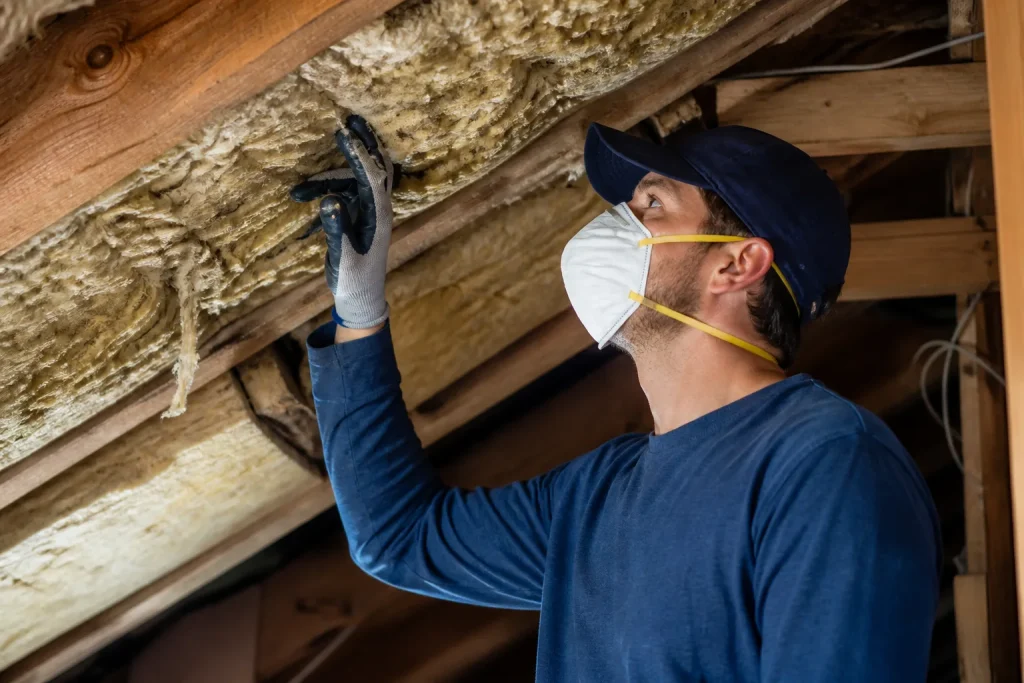
You don’t need to crawl into your attic to spot insulation problems. You need a flashlight, a tape measure, and about thirty seconds at the hatch.
Here’s the first read we do on any Los Angeles home:
Step 1: Open the attic hatch and shine the flashlight across the floor of the attic. You’re looking for uniformity. Healthy insulation should look like a consistent blanket, not rolling hills with bare valleys.
Step 2: Look for gaps near the edges. The perimeter of the attic – where the roofline meets the ceiling joists – is where insulation pulls away first. If you can see the drywall or the top of the ceiling joists poking through anywhere, that’s a problem.
Step 3: Check the depth. Fiberglass batts in Los Angeles should sit at roughly R-30, which translates to about 10 to 11 inches when new. Blown-in insulation settles too. If your tape measure shows 5 or 6 inches where there should be 10, you’ve lost a third or more of your thermal barrier.
Step 4: Look for dark streaks or matted-down patches. That’s where moisture has been, or where air from the living space has been pushing through and compacting the fibers. Insulation doesn’t fail uniformly. It fails in spots, and those spots are where the heat gets through.
We’ve walked homeowners through this exact process over the phone dozens of times. A woman in Silver Lake called us last fall convinced she needed a new AC unit because her upstairs bedroom hit 88 degrees every afternoon. She opened the hatch, measured three inches of compressed fiberglass where there should have been ten, and saved herself about eight thousand dollars. The AC was fine. It had been fighting a losing battle against a ceiling that was basically uninsulated.
The Pest-Activity Indicators You Can Spot Without Seeing the Problem
Rats, mice, squirrels, and racoons all find their way into Los Angeles attics. And when they do, they don’t just live in the insulation – they shred it, compress it into nests, and leave behind waste that turns the whole attic into a biohazard.
Here are the signs that mean your insulation is compromised even if it looks okay from the hatch:
- Odor, especially on warm days. Urine and droppings bake in the attic heat and produce a smell that’s different from mustiness – it’s sharper, more acrid, and it tends to come and go with temperature swings.
- Dust trails near ceiling vents and light fixtures. Attic dust falls through the same gaps that air moves through. If you’re seeing gray-brown dust collecting around specific vents, something is moving above them, and insulation fibers are getting kicked loose.
- Debris patterns on the attic floor. Shine that flashlight around. Pest traffic creates paths – flattened, winding trails through the insulation that look like crop circles when you view them from the hatch.
- Chewed wiring or gnawed wood. Rats and squirrels chew constantly. If you see chew marks on joists or wiring near the hatch, they’ve been through the insulation too.
- Sounds at dawn and dusk. Scratching, scurrying, or what sounds like marbles rolling across the ceiling. That’s not the house settling. That’s a resident.
Here’s the part most homeowners don’t realize: once pests have lived in your insulation, the R-value is shot, but so is the indoor air quality. The waste doesn’t just sit there. It dries, becomes particulate, and gets pulled into your living space through every gap in the ceiling. You’re breathing it. In Los Angeles, where attic temperatures routinely hit 130 degrees on summer afternoons, that material bakes and off-gasses all day.
Insulation that’s been compromised by pests needs to be removed and replaced. No amount of air sealing or spot-patching fixes a contaminated attic.
Why LA’s “Mild” Climate Actually Makes Insulation Fail Faster
People assume insulation lasts longer in Los Angeles because we don’t get harsh winters. The opposite is true, and it’s specific to how our climate works.
In cold climates, insulation degrades through freeze-thaw cycling. Moisture freezes, expands, contracts, and slowly breaks down the material. That’s slow, regular wear.
Los Angeles has a different problem: sustained heat loading. Your attic hits 120 to 140 degrees on a typical August afternoon, and it stays hot for months. UV-adjacent radiant exposure – the heat that pours through the roof deck and bakes everything below it – breaks down the binders in fiberglass batts and accelerates settling in blown-in products. Add the dry air, which pulls moisture out of everything, and you get insulation that becomes brittle, dusty, and less effective years before it would fail somewhere with snow.
We’ve pulled ten-year-old insulation out of attics in the Valley that looked and performed like thirty-year-old material from a house in the Midwest. It was dust. You could see through it in places. The homeowner assumed R-30 meant R-30 in any climate, but R-value is measured under ideal lab conditions, not after a decade of 130-degree afternoons.
If your home in Los Angeles is more than 15 years old and you’ve never had the attic checked, the odds are good that your insulation is underperforming, even if it looks “fine” from a quick glance. This isn’t a scare tactic. It’s just what sustained heat does to fiber.
The Utility Bill Method: How to Read 12 Months of Data Like a Diagnostic Tool
Your utility history is the cheapest diagnostic test available. Southern California Edison and SoCalGas both let you download 12 months of usage data online, and that data tells a specific story.
Here’s how to read it:
- Pull 12 months of SCE electric data. You want monthly kWh, not just dollar amounts. Rates change, but usage is usage.
- Find your baseline. Look at months where the AC isn’t running at all – typically November through March in most parts of Los Angeles. That’s your non-cooling load. Average those months.
- Look at July, August, and September. Subtract your baseline from those months. What’s left is your cooling load – how hard your AC worked to fight the heat.
- Compare year over year if you have older data. If your cooling load increased by 20% or more without a matching change in household habits, the most likely explanation is insulation loss.
- Check SoCalGas the same way for winter months. Homes in Los Angeles with failed or missing attic insulation also lose heat faster on cold nights, which means the furnace cycles more often than it should.
The pattern you’re looking for is a cooling-load increase that outpaces the weather. Yes, some summers are hotter than others. But if you cross-reference your usage with the CDD (cooling degree day) data that SCE publishes, you can see whether your home got worse at handling the same amount of heat. That’s the insulation talking.
We’ve run this analysis for homeowners who were convinced they needed new windows. The data said otherwise. Their cooling load was climbing every July while the windows hadn’t changed at all. The attic had. Re-insulating cut their summer bills by more than a third in several cases, entirely because the AC stopped running two extra hours a day.
When to call a pro: If any of these signs are matching up – the hot upstairs rooms, the pest evidence, the climbing cooling load – you want a professional looking at that attic before you spend money on anything else. A good insulation contractor can diagnose the problem, give you a written price, and tell you whether it’s a spot fix or a full replacement. And the sooner you address it, the less damage accumulates. Heat doesn’t take a year off.
Related services in Los Angeles: If your attic insulation is failing, the fix might be attic insulation in Los Angeles, spray foam insulation in Los Angeles, or blown-in insulation in Los Angeles, depending on your attic’s layout and current condition.
The Bottom Line
Attic insulation fails quietly. It settles. It gets shredded by pests. It bakes in the Los Angeles heat until it’s dust, and the whole time, your AC runs harder and your bills climb and you assume the problem is everything except what’s above your head. The signs are there – the hot roofline rooms, the matted insulation visible from the hatch, the unexplained cooling-load increase on your SCE bill. You just have to look for them in the right order.
If you’re in Los Angeles and any of this sounds familiar, Aspen Attic Insulation offers free estimates. We’ll check your attic, tell you what’s actually wrong, and give you a written price before any work starts. Call (864) 428-1615. We answer the phone. A real person, every time.
Frequently Asked Questions
You likely need new attic insulation if upstairs rooms under the roofline run 4+ degrees hotter than the rest of the house, if you can see bare or thin spots from the attic hatch, or if your cooling load on your SCE bill has increased significantly year over year. Any one of these is worth checking. All three together usually mean the insulation has failed. Call us at (864) 428-1615 for a free inspection if you’re not sure what you’re seeing.
Bad attic insulation looks thin, uneven, matted down, or dark-stained. You might see gaps near the roofline edges, compressed patches where air has been pushing through, or debris trails from pest activity. In Los Angeles, insulation that’s been in place more than 15 years often looks dusty and sunken, even if no one’s touched it. A flashlight and a quick look from the hatch is usually enough for a first read.
Sometimes, but not always. If the old insulation is dry, pest-free, and just thin, adding new material on top can work. If it’s been contaminated by rodents, soaked by a leak, or compressed into a dense mat, it needs to come out first. Adding fresh insulation over problems doesn’t fix them – it buries them. We’ll tell you which situation you have before recommending anything, and the price is in writing either way.
In Los Angeles, yes, usually by a noticeable amount in summer. When your attic is properly insulated, your AC doesn’t run as long to maintain the same temperature, which directly reduces your kWh usage. We’ve seen SCE bills drop by 20 to 35 percent in homes where the attic insulation was severely degraded. The exact number depends on your home’s size, orientation, and how bad the current insulation is. Call (864) 428-1615 and we can give you a more specific sense of what to expect after looking at your attic.
Written by Aspen Attic Insulation at Aspen Attic Insulation, serving Los Angeles.
Need Insulation Help?
Call Aspen Attic Insulation - licensed & insured, here with fast after-hours help in Los Angeles.
(864) 428-1615