
Johns Manville Attic Insulation in Los Angeles: A Homeowner’s Guide
Johns Manville attic insulation in Los Angeles is a solid product line, but the R-value printed on the bag means very little if the crew in your attic doesn’t install it to spec. Most Los Angeles attics we inspect fall 18 to 22 percent short of their target R-value because installers skipped the depth verification cards Johns Manville requires. If you’re considering this brand, or already have it and suspect it’s underperforming, this guide tells you what to watch before, during, and after installation day. If you’d rather not climb into your attic at all, call us at (864) 428-1615 and we’ll inspect it for free.
What Johns Manville Products Actually Work in Los Angeles Attics
Johns Manville makes two attic insulation systems that matter for Los Angeles homes: AttiCat blown-in loose fill and Climate Pro blown-in batts. The right choice depends on your attic’s shape, not the marketing. We’ve worked on plenty of older Spanish-style homes in the Valley where the attic has shallow joist bays and ductwork snaking through. AttiCat blown-in (loose fibers blown into the attic cavity to fill every gap) handles those awkward spaces far better than batts, which leave seams and gaps around obstacles. Climate Pro batts work fine in open, rectangular attics with consistent joist spacing, but they demand careful cutting and fitting around cross-bracing and recessed lights. Ranch homes in the San Fernando Valley often have lower-pitched ceilings and tight eaves: blown-in gets into those corners, batts get crushed trying to follow. Here’s the practical difference:
- AttiCat blown-in: best for irregular attics, older homes, attics with lots of ductwork or wiring, and anyone wanting maximum air-sealing coverage.
- Climate Pro batts: workable for simple, rectangular attic layouts with standard joist spacing, but require meticulous installation to avoid compression.
For most Los Angeles attics we see, AttiCat is the better fit simply because our housing stock is older and nothing about a 1950s attic is standardized. Ask whoever bids the job which product they’re quoting and why. If they can’t answer that in one sentence, that’s your signal to keep looking.
What Johns Manville’s Installation Requirements Actually Say
Here’s where Los Angeles homeowners get shortchanged. Johns Manville publishes installation specs that are remarkably specific, and those specs exist because the product doesn’t perform unless they’re followed. AttiCat’s published coverage chart ties the required number of bags directly to your square footage and target R-value. For an R-38 attic in a 1,200 square foot Los Angeles home, the spec sheet calls for a specific bag count and specifies fewer bags always means less R-value, period. The system also requires installers to use depth verification cards: marked rulers placed throughout the attic that show exactly how deep the insulation sits in multiple locations, not just the spot nearest the access hatch. In our experience, crews under pressure skip the cards and eyeball it. We pulled an under-installed AttiCat job apart over in Sherman Oaks recently where the homeowner had paid for R-38 and got R-28 in half the attic because depth markers never went in. We fixed it, but that’s a $1,600 mistake that never should have happened.
What you can verify on installation day:
- Ask the crew where the depth verification cards are going. If they pause or point vaguely, ask again.
- Count the bags delivered. The number should match the square footage calculation on your written estimate.
- After installation, the insulation surface should be level, not lumpy or scooped out near eaves.
- No compressed or matted-down areas around the attic hatch, plumbing vents, or recessed light housings.
This guide isn’t about installing it yourself. Blown-in insulation requires a machine, proper respirators, and experience reading depth across uneven attics. Get a crew that follows the spec, and you won’t need to think about it again.
Why R-38 Is Often Underpowered for Los Angeles Cooling Loads
The national default recommendation for attic insulation is R-38, and most Los Angeles homes have R-19 or less. But here’s what national guidelines miss: Los Angeles’s problem isn’t winter. It’s a five-month cooling season where attics hit 140 degrees and your air conditioner fights that heat all afternoon. R-38 represents a meaningful improvement over old R-19, but if you’re paying for a full re-insulation anyway, R-49 or R-60 costs incrementally more in material and delivers disproportionately better summer performance. The difference between R-38 and R-60 in a Los Angeles August isn’t theoretical: it’s the difference between an attic floor that radiates heat into your living space and one that mostly doesn’t. In our experience, Los Angeles homeowners who go to R-60 report noticeably flatter indoor temperatures across the house, especially in single-story ranches where the attic covers the entire living area.
Johns Manville’s AttiCat is rated for R-60 coverage, but the installer has to actually put the full bag count down. Many crews quote R-38 because it’s the default everyone else quotes. Ask for R-49 at minimum if you’re re-insulating. The incremental cost is modest, and Los Angeles summer afternoons are long.
The Two Warranty Documents You Should Have in Hand
Johns Manville offers a product warranty. Your contractor offers a workmanship warranty. These are not the same document, and Los Angeles homeowners frequently don’t realize they need both. The Johns Manville product warranty covers defects in the material itself: if the product fails due to a manufacturing issue. It does not cover a crew that under-installed the product, skipped depth markers, or left gaps around recessed lights. That’s the contractor’s workmanship warranty, and in Los Angeles, too many insulation companies offer vague verbal commitments instead of anything written.
Before any work starts, ask for both documents. The product warranty should come from the insulation brand (Johns Manville, Knauf, Rockwool, or CertainTeed, depending on what’s being installed). The workmanship warranty should come from the insulation company, in writing, with a clear duration and a clear statement of what it covers. At Aspen Attic Insulation, every job carries a Done Right Promise: if the installation isn’t done right, we make it right, in writing, covering labor and materials for a full year. If a repair fails within that year, the second visit is free. That’s the kind of written guarantee that should be normal in this industry, and if a Los Angeles contractor won’t put it on paper, that’s an answer in itself.
What a Proper Johns Manville Installation Looks Like When It’s Done
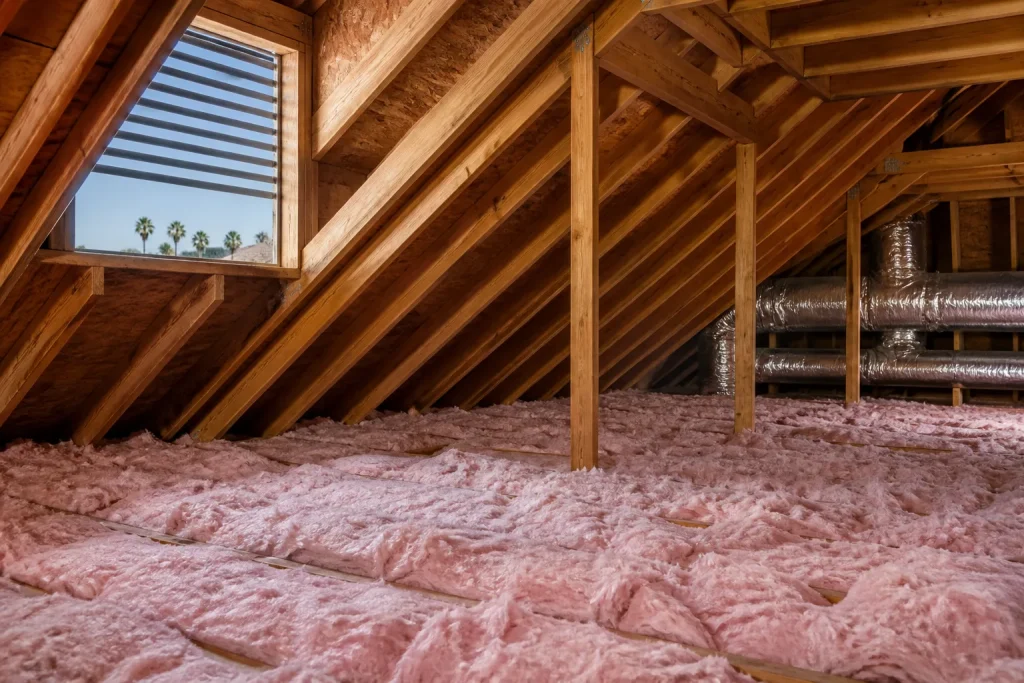
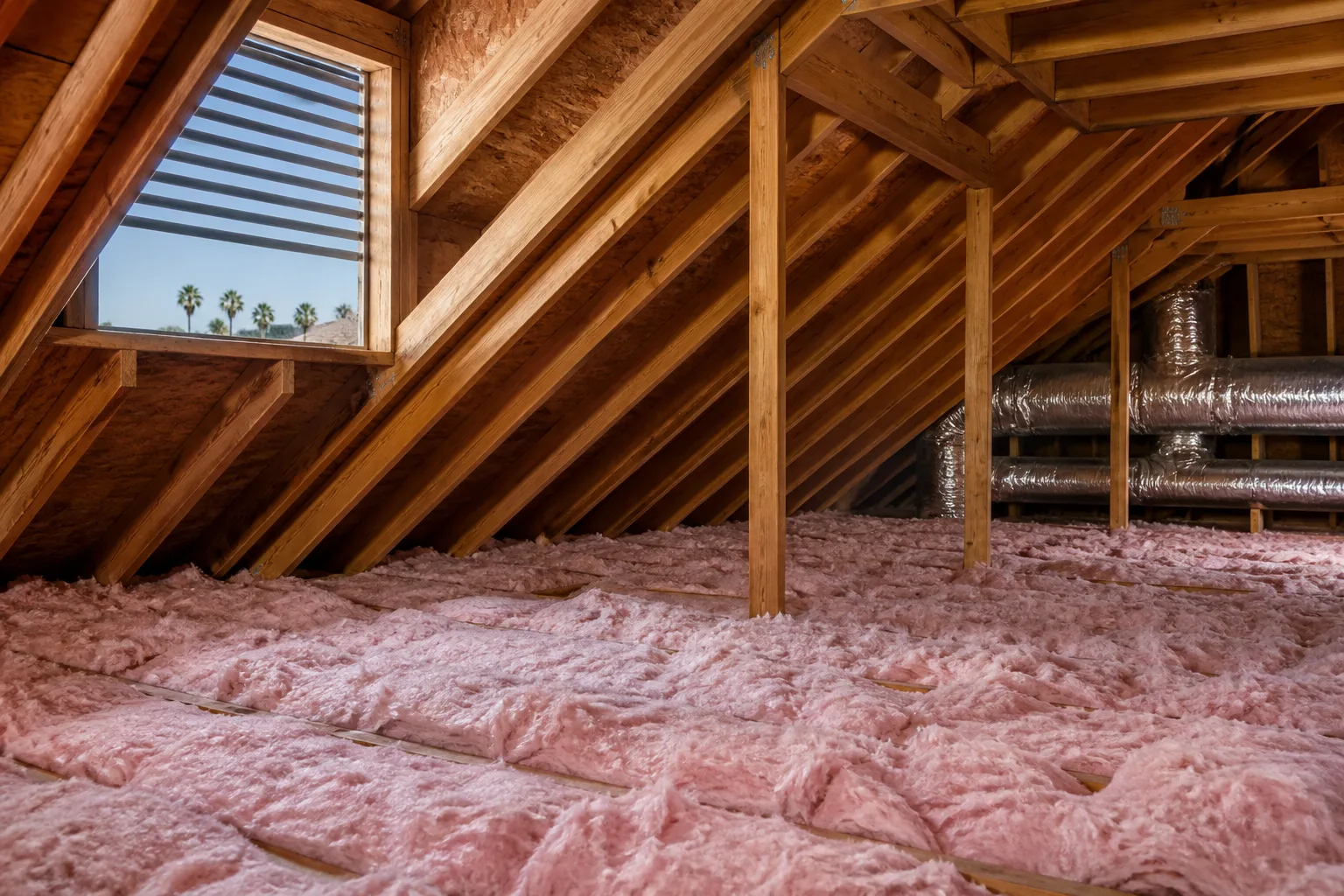
Most Los Angeles homeowners never look in their attic after the crew leaves. We encourage you to. Not because you need to become an insulation expert, but because finished attics tell you very quickly whether the installer cared. A proper Johns Manville blown-in installation has a specific visual signature:
- Depth indicators visible: you should be able to spot the depth verification cards or rulers standing in the insulation at multiple points across the attic floor.
- No compressed areas near eave baffles: where the roof meets the outside walls, the insulation should stay fluffy and full-depth, not smashed down to make room for walking.
- No gaps around recessed lights: insulation should surround can lights without touching them (for fire safety), but there shouldn’t be bare attic floor exposed around the fixture.
- Level surface overall: the insulation should look like settled snow, not a washboard.
- Access hatch insulated: the hatch or pull-down stair should have insulation attached to its top side, otherwise it’s a hole in your thermal envelope.
If you see matted-down paths where the crew walked, large bare patches, or depth cards clustered only near the hatch, document it with photos and call the contractor. These are the exact deficiencies that cause the 18 – 22 percent R-value shortfalls we see on Los Angeles audits, and they’re fixable if caught early.
For more on how insulation performs in Los Angeles specifically, see our guide to Attic Insulation in Los Angeles. If you’re considering whether blown-in or spray foam fits your home better, our Spray Foam Insulation in Los Angeles and Blown In Insulation in Los Angeles pages break down the tradeoffs for Southern California attics.
When to Call a Professional
If any of the following applies to your Los Angeles home, a professional evaluation saves you time and likely money: your attic insulation is original to a pre-1990 home, you can see the ceiling joists above the insulation, interior rooms feel noticeably warmer than the rest of the house in summer, or a previous contractor can’t produce depth verification for work already done. Insulation mistakes compound: an under-insulated attic costs more every summer, and a poorly installed job needs full remediation, not a top-off.
We’ve been doing this in Los Angeles, and the pattern holds: the best insulation jobs are the ones where the homeowner understood enough to ask the right questions and the contractor welcomed those questions. Every Aspen Attic Insulation technician is background-checked, identity-verified, and arrives in a marked uniform with a photo ID badge. We send you the technician’s name and photo before the visit so you know exactly who’s showing up. If anyone else arrives, the visit is free and we make it right. That’s the Threshold Standard, and it’s how we’ve always operated.
The Bottom Line
Johns Manville’s AttiCat and Climate Pro are capable insulation products for Los Angeles attics, but the product is only half the equation. The other half is the crew: their bag counts, their depth verification, their care around eaves and recessed lights. Los Angeles homeowners should demand R-49 or higher for summer cooling loads, insist on seeing depth markers, and collect both the product warranty and the contractor’s workmanship warranty in writing before work starts. If you’re in Los Angeles and need help evaluating your attic insulation, Aspen Attic Insulation offers free estimates. Call (864) 428-1615 and a live person answers, 24/7. We’ll give you a written price before any work begins, and every job carries our Done Right Promise in writing.
Frequently Asked Questions
Johns Manville blown-in attic insulation in Los Angeles typically runs $1,800 to $3,600 for a standard 1,200 square foot attic going from R-19 to R-49, including labor and materials. The price varies based on your current insulation depth, attic accessibility, and whether air sealing is included. Call (864) 428-1615 for an exact written quote, estimates are free.
For most Los Angeles homes, yes. AttiCat blown-in fills irregular cavities, wraps around ductwork, and reaches the awkward angles common in older Spanish-style and ranch homes. Climate Pro batts work in simple rectangular attics but demand precise cutting and fitting. The right choice depends on your attic’s layout, which is why we recommend an inspection before quoting.
Yes, a standard Los Angeles attic can typically be insulated with Johns Manville AttiCat in four to six hours, including setup and cleanup. Larger attics or projects requiring old insulation removal take longer. Call (864) 428-1615 and we’ll give you a written price and timeframe before any work starts.
Johns Manville provides a product warranty covering material defects, but the installation workmanship warranty comes from your contractor. Los Angeles homeowners should ask for both documents in writing before work begins. At Aspen Attic Insulation, every job is covered by our Done Right Promise in writing, covering labor and materials for a full year with a free second visit if a repair fails.
Written by the team at Aspen Attic Insulation.
Need Insulation Help?
Call Aspen Attic Insulation - licensed & insured, here with fast after-hours help in Los Angeles.
(864) 428-1615