
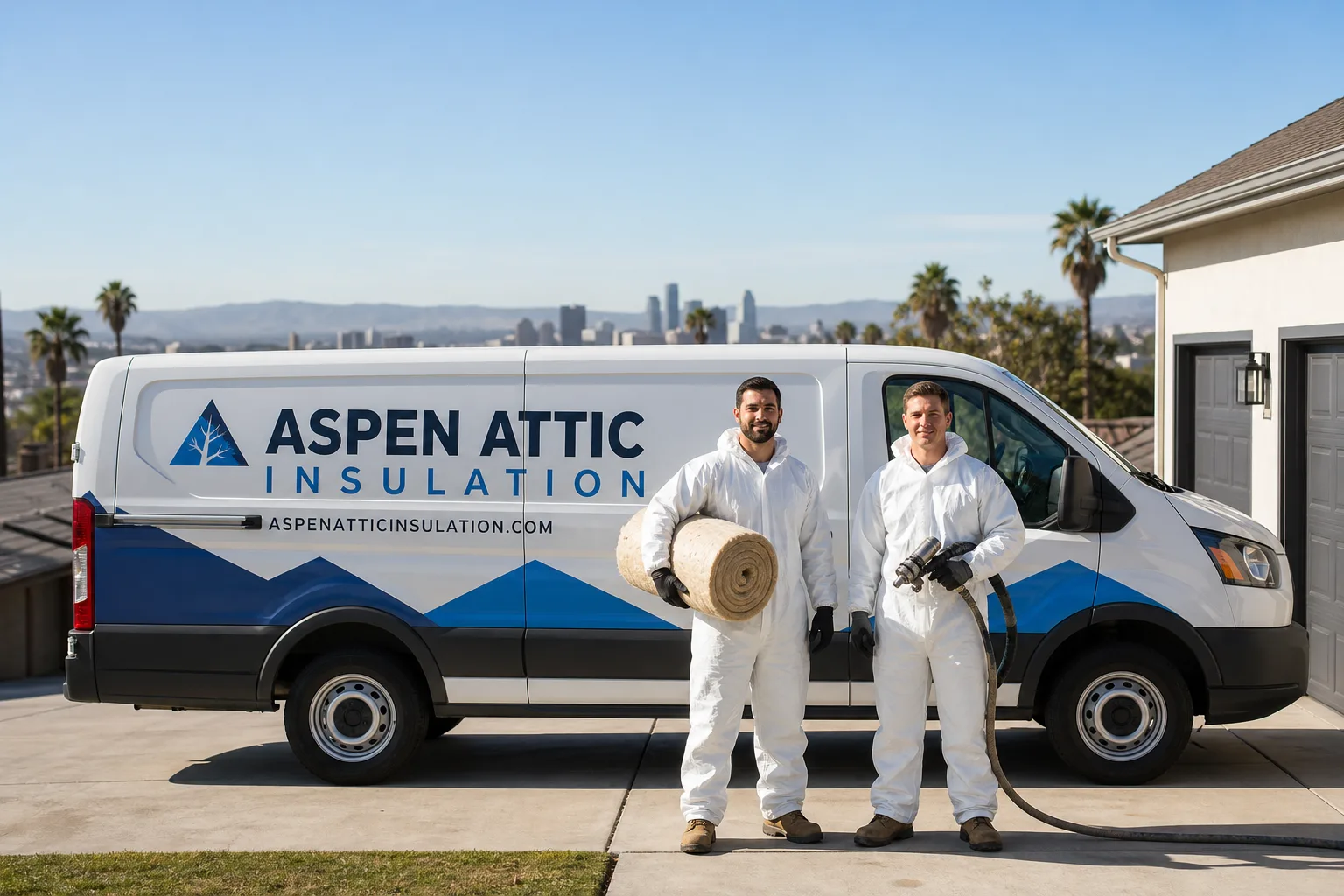
Fast, Reliable Spray Foam Insulation Across Castro Valley
Spray foam insulation in Castro Valley typically costs $1,800 – $4,500 for most residential jobs, with closed-cell running higher than open-cell due to density and R-value. Most Castro Valley homes we foam are completed in a single day, and our crew can usually be on-site within 24 – 48 hours of your call. We’re the Spray Foam Insulation crew that serves Castro Valley from our San Francisco Bay Area dispatch office, with trucks stocked for the specific thermal cycling problems this valley creates.
Castro Valley isn’t coastal fog. It’s canyon mornings in the 40s and valley afternoons in the 90s, sometimes within hours. That rapid swing destroys standard fiberglass batts in west-facing attics and creates condensation on metal shop doors that most Bay Area crews never see. We design for it. Our technicians are background-checked, photo-badged, and sent to you by name and photo before anyone knocks. You’ll get a written price before we start, and every job carries our 365-Day Done Right Promise in writing. Call (864) 428-1615 for a free estimate.
Why Aspen Attic Insulation Is Castro Valley’s Preferred Spray Foam Insulation Company
We’ve been foaming attics, rim joists, and detached shops in Castro Valley long enough to know the difference between a flatlands ranch off Castro Valley Boulevard and a canyon property up Palomares Hills Road. The valley’s 1950s-1970s housing stock, those Eichler-inspired ranches and split-levels with original wood framing and minimal wall insulation, requires a different approach than the stucco tract homes our San Lorenzo neighbors built a decade later.
Our Castro Valley customers tell us the same thing: they want to know who’s coming, what it will cost, and that the fix will last through those 40-degree-to-90-degree swings. That’s why we send every technician’s name, photo, and ID badge details before the visit. If anyone else shows up, the visit is free and we make it right. Our 365-Day Done Right Promise covers labor and materials in writing, with a free second visit if a repair fails. Calls are answered by a live person 24/7, never a voicemail loop.
We carry eight premium brands on our trucks, including Owens Corning, Johns Manville, and Knauf, so we match the material to your specific cavity, not just what we have left.
Closed Cell Spray Foam Insulation in Castro Valley
Closed Cell Spray Foam Insulation in Castro Valley is the dense, rigid foam we use when a cavity needs maximum R-value per inch and a built-in vapor barrier. In Castro Valley’s canyon neighborhoods, where west-facing attics bake in afternoon sun and winter mornings drop below 45 degrees, closed-cell foam holds its shape and R-value where fiberglass batts sag and compress within a few seasons. A typical closed-cell job in Castro Valley runs $2,800 – $4,500 for an average attic or rim-joist application, with garage ceilings and roof decks scaling from there based on square footage and access.
Where We Use It
We spec closed-cell for Castro Valley’s unvented attics, steel-shop condensation problems, and any cavity where space is tight but R-value can’t be compromised. The 2-pound density creates a monolithic air barrier that stops the canyon wind from short-cycling your heater.
What the Job Looks Like
Our crew masks off, removes degraded existing material, then sprays a uniform lift to the specified thickness. We use Icynene and Demilec closed-cell formulations matched to your framing depth. Every step follows The Threshold Standard, our verification protocol for technician conduct and material handling.
Open Cell Spray Foam in Castro Valley
Open Cell Spray Foam in Castro Valley is the lighter, more flexible foam we use in larger cavities where R-value per inch is less critical than complete fill and sound dampening. At roughly half the density of closed-cell, it expands aggressively to seal irregular framing in the quirky additions and retrofits common to Castro Valley’s hillside homes. A typical open-cell job in Castro Valley runs $1,800 – $3,200 for attic applications, with wall cavities and garage ceilings priced by board-foot volume.
Best Applications
Open-cell excels in Castro Valley’s vented attics, interior wall cavities, and detached workshop ceilings where the primary goal is air sealing and thermal continuity rather than vapor blocking. We often pair it with strategic closed-cell at critical junctions.
The Installation Difference
Because open-cell expands 100:1, it finds gaps in the inconsistent stud depths of 1960s ranch retrofits that batt insulation simply bridges over. Our technicians trim flush and verify complete fill before closing any cavity. You get photos, not promises.
Trusted Brands We Service in Castro Valley
We stock materials from eight industry-leading brands on every Castro Valley job: Owens Corning, Johns Manville, Knauf, Rockwool, CertainTeed, Icynene, Demilec, and GreenFiber. For Castro Valley’s thermal cycling demands, we typically reach for Owens Corning closed-cell formulations in west-facing attic envelopes and Knauf open-cell for interior wall fills in split-level retrofits. Having the full range on hand means we don’t substitute mid-job because a warehouse across the Bay is out of stock. Your written estimate specifies the exact product by brand and series, and that’s what goes in. If we need to deviate, we stop and get your approval in writing before the trigger is pulled.
Common Spray Foam Insulation Problems We See in Castro Valley Homes
- Sagging fiberglass batts in west-facing canyon attics. The afternoon bake off Palomares Hills and Redwood Road west slopes compresses standard batts until they lose 30-40% of rated R-value. Homeowners call us thinking they need more insulation, when what they need is insulation that won’t collapse under thermal stress.
- Flash-and-batt retrofits with inconsistent foam thickness. On 1950s-70s ranch and split-level homes, original framing depths vary wall to wall, especially where owners added sunrooms or expanded kitchens. Foam sprayed to a uniform pass depth leaves some cavities underfilled and others overfilled, creating thermal stripes you can feel at the drywall.
- Open-cell on canyon shop roofs without vapor management. That 40-degree morning to 90-degree afternoon swing drives moisture through open-cell’s permeable structure. Without a vapor-closed layer or proper exterior drying, condensation forms on steel door panels and roof decking, rusting hardware and dripping onto stored equipment.
- Unsealed top plates and rim joists in Eichler-inspired ranches. The flat-roof and low-slope designs common to Castro Valley’s 1960s builds create continuous thermal bridges at the wall-to-roof junction. Foam the attic but skip the rim joist, and you’ve left a highway for canyon wind.
Pricing for Spray Foam Insulation in Castro Valley, CA
Here’s what spray foam insulation costs in Castro Valley’s current market:
- Open-cell attic spray foam: $1,800 – $3,200
- Closed-cell attic or rim-joist foam: $2,800 – $4,500
- Garage ceiling spray foam (standard 2-car): $2,200 – $3,800
- Spray foam roof deck (vented or unvented assembly): $3,500 – $6,000
- Detached workshop or outbuilding: $1,200 – $2,800 depending on square footage and access
What moves you within these ranges: cavity depth and square footage, existing material removal, access difficulty (steep canyon driveways add setup time), and whether we need to spec closed-cell for vapor control. Every Castro Valley estimate is free, written, and delivered before any work starts. No post-job add-ons, no “we found something” surprises. Call (864) 428-1615 to schedule yours.
We Also Serve Cities Near Castro Valley
Our crews run regular routes to San Lorenzo, San Leandro, Union City, and Dublin from the Bay Area dispatch office. If you’re in the wider East Bay and your home faces the same canyon-to-valley thermal swings, we can spec the same foam systems and send the same verified technicians. Scheduling is coordinated locally, not from a distant call center.
Serving Castro Valley, CA - Our Local Coverage Area
We’re based in the Castro Valley area and know this community well. Use the map below to see our service coverage - if you’re nearby, we can almost certainly help.
FAQs About Spray Foam Insulation in Castro Valley
Fiberglass batts sag and compress in west-facing canyon attics within 3 – 5 years due to the daily 40-to-90-degree thermal bake. Spray foam adheres directly to framing, maintains its R-value through thousands of expansion-contraction cycles, and air-seals simultaneously. We stopped counting how many Castro Valley homeowners we’ve re-foamed after a batt replacement failed. Call (864) 428-1615 and we’ll show you the difference in your own attic.
Yes. We regularly foam detached shops, barns, and outbuildings from the flatlands off Strobridge Avenue up to the canyon properties near Lake Chabot. We seal roll-up door headers, foam ceiling cavities, and spec vapor-appropriate closed-cell where metal doors and steel panels create condensation risk. Every job gets the same written price and 365-day guarantee.
These homes typically have minimal original insulation, unvented or poorly vented attics, and flat or low-slope roof planes that trap heat. We design for continuous insulation at the roof deck or ceiling plane, seal all top plates and penetrations, and often spec closed-cell to manage the limited cavity depth. The goal is stopping the stack effect that pulls canyon-cold air through the living space every morning.
Closed-cell foam alone won’t stop surface condensation on a cold steel door, but properly foaming the header, jambs, and adjacent wall cavity eliminates the thermal bridging and air leakage that creates the cold spot. In Castro Valley’s canyon shops, we often pair closed-cell cavity fill with targeted air sealing at the door frame to stop the short-cycling that loads the door with moisture. Call (864) 428-1615 for a specific assessment of your shop’s envelope.
Yes, significantly. Spray foam is an adhesive insulation that bonds to substrates and flexes microscopically with thermal movement. Fiberglass batts rely on loft and friction fit, both of which degrade under repeated expansion and contraction. In Castro Valley’s diurnal swing environment, a batt upgrade is often a 3 – 5-year fix; foam is a 20-plus-year solution. Our 365-Day Done Right Promise covers the installation, and the material warranty runs decades beyond that.
Written by Garrett Sloane, Owner at Aspen Attic Insulation, serving Castro Valley since 2002.